E-Lit in the LoC: A Writeup

Thursday 25 April 2013, 5:23 pm   /////  

There’s a nice article by Illya Szilak, with a discussion/reporting by Melinda White, about the Library of Congress Electronic Literature Showcase. This ran April 3-5; I was down there to read from Ad Verbum and Taroko Gorge and to speak about electronic literature’s history with libraries on the last day of the event and exhibit. And it was an excellent exhibit.

A New Trope Report on E-Lit Readings & Exhibition

Tuesday 23 April 2013, 11:04 pm   ////////  

Thanks to Dr. Clara Fernández-Vara, the Trope Tank has a new technical report, TROPE-13-01: “Electronic Literature for All: Performance in Exhibits and Public Readings.”

This report covers readings of interactive fiction done by the People’s Republic of Interactive Fiction, the Boston area IF group, and the exhibit Games by the Book, discussed previously on here. But there is much more detail in this report about how these attempts managed to share computational works (works that are both games and e-lit) with the public. If you are interested in outreach and presentations of this sort, please take a look.

Chercher le Text Call for Artistic Works

Tuesday 15 January 2013, 6:22 pm   ///////  

Here is the call for artistic proposals for the ELO 2013 “Chercher le Text” in Paris!

The “chercher le texte” event deals with literary issues and text-oriented multimedia practices on digital devices: digital books, texts generated or animated through programming, fiction hypertexts, “manipulable”, playable works, or on the contrary works whose very program embraces literariness. The considered devices range from computers to mobile devices, including social networks. They can be used in various contexts: installations, performances, personal devices designed for digital reading. These contexts range from solo reading to collaborative or participative reading.

This event will represent an opportunity to showcase young artists and bring together two worlds, which otherwise barely come into contact with one another: that of the experimental digital literature forms deriving from the second half of the 20th century avant-garde movements and that of the digital writings, as used by authors coming from the book world and who have taken over the digital technologies, namely blogs and e-books. In this context, the Musique et Informatique de Marseille (MIM) laboratory associates with team Écritures Numériques from Paris 8 Paragraphe laboratory, the digital literature European network Digital Digital Digital Littérature (DDDL), the Electronic Literature Organization (ELO), the Bibliothèque Publique d’Information (BPI), the Bibliothèque Nationale de France (BNF), the Cube, the Labex Art-H2H coordinated by Paris 8 and the École nationale supérieure des Arts Décoratifs (EnsAD) to organize the following events:

  • An online virtual gallery on the DDDL network website.
  • Four events consisting of performances and projections of works, from September 23 to 26, 2013, in the small room of the Centre Pompidou, the big auditorium of the Bibliothèque Nationale de France and the Cube amphitheater.
  • A six-week exhibition on “digital literatures from the past and future” in the BNF lab room of the Bibliothèque Nationale de France, which will be launched on September 24, 2013. This exhibition will feature the virtual gallery and a selection of digital literary works with emphasis on the works designed for touch-pads and e-readers.

Artists, especially young ones, are invited to propose one or several work(s). Please send your proposals to work@chercherletexte.org before February 18.

This is a summary of the call – see www.chercherletexte.org for full details.

The Tale of the MLA E-Lit Exhibit, Reading

Monday 14 January 2013, 12:54 am   ///////  

Kathi Inman Berens storified some nice media elements relating to the 2013 electronic literature exhibit and reading at the MLA Convention.

10 PRINT Marches on

Monday 7 January 2013, 11:34 pm   //////  

The news service of my school at MIT, the School of Humanities, Arts, and Social Sciences, has an article about 10 PRINT CHR$(205.5+RND(1)); : GOTO 10.

Also, there has been some furious and pretty amazing program creation and compaction going on in DOS/x86 land. It all seems to have started when demoscener Trixter (a.k.a. Jim Leonard) decided to port 10 PRINT to x86 assembly. His first, straightforward version was 42 bytes long, but he was quickly able to chop it down by replacing the random number generator with a single instruction: 25 bytes. Getting ready of some of the nice and tidy but strictly unnecessary startup and shutdown code brought the program down to 15 bytes. Then, thanks to the clever use of an opcode that I’d never heard of before which is meant for string comparison and is called SCAS, he was able to trim the code to 13 bytes — the shortest he thought it could ever be.

Of course, someone (Peter Ferrie) found a way to get rid of another byte, so the program sat at 12 bytes long.

herm1t came along to provide an optimization that assumed DOS was loaded, reducing the program to 11 bytes.

And, most recently, Peter Ferrie returned to lop off another byte, showing that the program (on Intel CPUs, at least) need only be 10 bytes long.

Trixter provides the full story (so far!) on his blog, Oldskooler Ramblings.

My joke about this is that the shortest possible 10-PRINT-like program will be a single jmp instruction to a run of 8 or 9 bytes that happen to already be in memory. However, this is probably only a joke: the number of possible 8-byte combinations of bits are 256^8 = 18446744073709551616, so it really isn’t very likely, even for an extremely short program of this sort, that it will just happen to be lying around somewhere in memory initially.

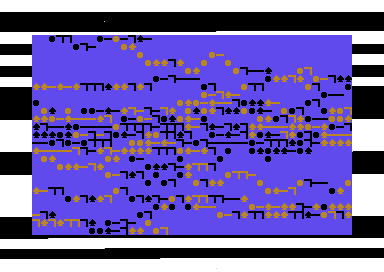
Speaking of the demoscene, I mentioned in my last post that viznut has checked out the book. He’s also written a very nice VIC-20 version of the program that uses two of the tiles from the Black Path Game instead of the original diagonal lines:

0 FORI=7168TO7183:READA:POKEI,A:NEXT:POKE36869,255
1 PRINTCHR$(64.5+RND(.));:GOTO1
2 DATA16,16,32,192,3,4,8,8,8,8,4,3,192,32,16,16

The result:

VIC-20 Black Path Game version of 10 PRINT

Finally, we had a great time exhibiting the 10 PRINT program and the 10 PRINT book at the 2013 MLA’s electronic literature exhibit and presenting the program and modifications of it at the MLA offsite electronic literature reading. Thanks to Dene Grigar and Kathi Inman Berens for curating the exhibit and the reading. And, thanks to Patsy Baudoin, Mark C. Marino, and Mark Sample for joining me for that presentation and for offering commentary (play-by-play and color) as I coded on the Commodore 64.

10 PRINT “HAPPY NEW YEAR”

Wednesday 2 January 2013, 12:00 am   ///////  

Happy new year!

A few updates related to our book 10 PRINT CHR$(205.5+RND(1)); : GOTO 10

Booksellers had some problems keeping the book in stock in recent weeks. The MIT Press is addressing this by printing more copies.

We learned in November, and were recently reminded by Finnish scener and programmer of one-liners viznut, that there is a pre-Commodore 64 version of the program. It’s in a fairly obvious place, too: The VIC-20 User’s Manual, on page 102. The program is identical to the first variant in our book (Variant 1982) except that the line numbers are 10, 20, and 30 instead of 10, 20, and 40. This wasn’t a big surprise to us, as we knew since early in the process of writing the book that the program worked not only on the Commodore 64 but also on the VIC-20 and the PET. It would have been nice to have documented this variant in the book, of course.

mjcohenw on Hacker News states that the program originated even earlier:

I discovered this on my Commodore PET probably about 1980 and presented it at a users’ group meeting (in the Los Angeles area). I have no way to prove this right now, but I swear that this is true.

So, there’s a testament to the program being written and shared on the PET even earlier. That it comes from human memory, and not from some print source, should be no surprise to readers of 10 PRINT.

Finally, I’ll note that 10 PRINT appears as one of the “creation stations” at the 2013 Modern Langauge Association Convention. The exhibit it’s in, Avenues of Access: An Exhibit & Online Archive of New ‘Born Digital’ Literature, will be in room 312 in the Hynes Veterans Memorial Convention Center. Exhibit times are:

Thursday, 3 January, 12 Noon to 7:00 p.m.
Friday, 4 January, 9:00 a.m. to 7:00 p.m.
Saturday, 5 January, 9:00 a.m. to 7:00 p.m.

The exhibit closes on Saturday afternoon and will not be open on Sunday.

There will be a reading to accompany the exhibit on Friday night, 8 p.m. to 10 p.m., at Emerson College’s Bordy Theatre, 216 Tremont Street. 10 PRINT will be part of that and will be presented by five of the book’s co-authors.

Purple Blurb Spring 2013: McIntosh, Di Blasi, Henderson

Friday 21 December 2012, 4:47 pm   //////  

Thanks to the good work of guest organizer Gretchen Henderson, the Purple Blurb schedule for Spring 2013 is already set! I hope to see you locals at some or all of them.

All Spring 2013 events are Mondays at 5:30pm in MIT’s room 14E-310. This is in the East wing of Building 14, across the building’s courtyard from the Hayden Library. Building 14 is not part of the Media Lab Complex. The Spring 2013 schedule is thanks to guest organizer Gretchen Henderson.

February 11, 5:30pm in 14E-310

Jason McIntosh

Presents the Interactive Fiction “The Warbler’s Nest”

The Warbler's Nest title image

Jason McIntosh is an independent games critic, designer, and scholar. During the previous decade, he produced “The Gameshelf”, a public-access TV series examining both tabletop and digital games, and “Jmac’s Arcade,” a set of video monologues on growing up within the arcade culture of the 1980s. More recently, he’s taught a game-studies lab at Northeastern University, published the XYZZY Award-winning work of interactive fiction “The Warbler’s Nest”, crafted the iPad edition of the tabletop game “Sixis” by Chris Cieslik, and worked as a game-design consultant for other clients. He continues to write game-criticism essays on The Gameshelf’s blog, and produces the occasional episode of the podcast series “Play of the Light”, which he co-hosts with Matthew Weise. His website collecting all this stuff may be found at jmac.org

March 11, 5:30pm in 14E-310

Debra Di Blasi

Skin of the Sun: Five Iterations Toward Human As Novel”

Followed by a discussion of the literary publisher’s role in the 21st Century

From Skin of the Sun

Debra Di Blasi is a multi-genre, multimedia author of six books, including The Jirí Chronicles & Other Fictions, Drought & Say What You Like, and Skin of the Sun. Awards include a James C. McCormick Fellowship in Fiction from the Christopher Isherwood Foundation, Thorpe Menn Book Award, Cinovation Screenwriting Award, and Diagram Innovative Fiction Award. Her fiction is included in a many leading anthologies of innovative writing and has been adapted to film, radio, theatre, and audio CD in the U.S. and abroad. Her essays, art reviews and articles can be found in a variety of international, national and regional publications. She frequently lectures on the intersection of literature and technology and is working on a nonfiction book on related topics.

April 8, 5:30pm in 14E-310

Gretchen E. Henderson

Galerie de Difformité:The Book as Body, The Body as Book”

Followed by an OPEN MIC!

From Galerie de Difformité

Gretchen E. Henderson is a Mellon postdoctoral fellow at MIT and a metaLAB fellow at Harvard, who writes across genres, the arts, and music to invigorate her critical and creative practices. She is the author of two novels, The House Enters the Street and Galerie de Difformité (winner of the Madeleine Plonsker Prize), a collection of nonfiction, On Marvellous Things Heard, and a poetry chapbook, Wreckage: By Land & By Sea. Among other projects at MIT, she is working on Ugliness: A Cultural History (for Reaktion Books), while continuing the collaborative deformation of Galerie de Difformité: a print book that is interfacing with the history and future of the book, networked online, inviting readers to participate in its (de)formation across media.

A Poetry Class for 36,000

Tuesday 4 December 2012, 7:24 pm   ///////  

December 10, 5:30pm in MIT’s 6-120

Al Filreis

Teaching Modern & Contemporary American Poetry to 36k

Al Filreis has taught his “ModPo” course at Penn for years; in Fall 2012 he offered a 10-week version of the course online, via Coursera, to more than 36,000 students. The course, as in its previous versions, does not include lectures, being based instead on discussion – the collaborative close readings of poems. The course grows out of Filreis’s work at the Kelly Writers House; he has been Faculty Director of this literary freespace since its founding in 1995. Filreis is also co-founder of PennSound, the Web’s main free archive of poetry readings, publisher of Jacket2 magazine, and producer and host of “PoemTalk,” a podcast/radio series of close readings of poems. In conversation with Nick Montfort, Filreis will discuss ModPo and his perspective on writing, teaching, and digital media.

Filreis is Kelly Professor of English and Director of the Center for Programs in Contemporary Writing at the University of Pennsylvania. He is the author of Wallace Stevens and the Actual World, Modernism from Right to Left, Counter-Revolution of the Word: The Conservative Attack on Modernism, 1945-60, and other works. He was chosen as Pennsylvania Professor of the Year by the Carnegie Foundation in 2000.

Co-sponsored by the SHASS Dean’s Office and the Literature Section.

All Purple Blurb events are free and open to the public. The Purple Blurb series is supported by the Angus N. MacDonald fund and Writing and Humanistic Studies.

10 PRINT Event, Post, Site, Photos

Thursday 29 November 2012, 9:52 am   ///  

Our event at the Boston Cyberarts Gallery (with me – Nick Montfort – Patsy Baudoin and Noah Vawter) went very well, with the gallery full for the salon and people willing up after the discussion to come program on the two Commodore 64s that we brought. There were some fascinating variants developed, too. Thanks to George for setting this up for us and to Dan and Bill for getting the space set so that the C64s could be powered up and connected to a projector.

Lev Manovich, one of the editors of the Software Studies series in which our book appears, writes of it:

10 PRINT was “coded” by 10 writers. However, rather than producing yet another academic anthology made up by independent parts, they made a coherent single “intellectual software” which executes beautifully.

We have a site for the book now at http://10print.org – you can download the entire contents, Creative Commons licensed, from the site there in a 50MB PDF. We’re happy to follow up on how the original program was shared in the 1980s by sharing our book in this way.

Finally, Casey Reas, our co-author and the designer of the book, has posted a set of photos of the 10 PRINT book. These are very effective in showing the care that Casey took in putting together the book, and how well it communicates the insights we reached together – and why you may enjoy reading the physical, printed 10 PRINT.

10 PRINT at the Boston Cyberarts Gallery

Tuesday 27 November 2012, 11:30 am   ///////  

As seen on Bruce Sterling’s blog, we have an 10 PRINT (or, to be precise, a 10 PRINT CHR$(205.5+RND(1)); : GOTO 10) event tomorrow, Wednesday, here in Boston. The Boston Cyberarts Gallery (formerly AXIOM) is located in the Green Street T station on the Orange Line; the event’s at 7:30pm.

An evening to celebrate the publication by MIT Press of 10 PRINT CHR$(205.5+RND(1)); : GOTO 10. This book takes a single line of code-the extremely concise BASIC program for the Commodore 64 inscribed in the title-and uses it as a lens through which to consider the phenomenon of creative computing and the way computer programs exist in culture. The ten authors of this collaboratively written book, treat code not as merely functional but as a text-in the case of 10 PRINT, a text that appeared in many different printed sources-that yields a story about its making, its purpose, its assumptions, and more.

They consider randomness and regularity in computing and art, the maze in culture, the popular BASIC programming language, and the highly influential Commodore 64 computer.

Nick Montfort will start off the evening leading a discussion among co-authors and the audience about this celebrated piece of software. And there will be a short hackathon.

ATNE Salons are informal discussions on art/technology topics. At each event, we start the discussion with a presentation by an expert in the field who’ll provide context and raise provocative questions. Next, with the help of a moderator, we turn the debate over to you. Share your ideas, discover new ones and participate in analytical discourse and artistic cross-pollination.

About Art Technology New England

ATNE is a member-run organization whose purpose is to foster existing and new collaborations in the New England art and technology communities, including non-profit, academic & corporate entities, as well as individuals.

When: Wednesday, November 28th, 7:30pm
Where: Boston Cyberarts Gallery,
141 Green St.,
Jamaica Plain, MA 02130

Free event!
RSVP to info [at] atne.org
www.atne.org

The People’s Republic of Interactive Fiction … Today

Tuesday 27 November 2012, 10:27 am   ////  

Boston-Area IF group The People’s Republic of Interactive Fiction (PR-IF) is set to meet at 6:30pm today in my lab, The Trope Tank (MIT’s room 14N-233). We’ll check out some of the winners of the 2012 Interactive Fiction Competition, the 18th annual Comp, which recently concluded. Congratulations to Marco Innocenti for his 1st-place Andromeda Apocalypse, to the anonymous author of Eurydice (which took 2nd), and to Jim Munroe, for Guilded Youth, which was 3rd – and to all of the other winners!

Submit to E-Poetry!

Friday 23 November 2012, 12:43 pm   //////  

The deadline for E-Poetry 2013 (to take place in London, at Kingston University) is almost here – sumissions are due December 1. The festival will take place June 17-20.

Tracy Fullerton this Thursday at MIT on “Walden, a game”

Tuesday 6 November 2012, 7:55 pm   ///////  

Tried of thinking about well-defined regions of red and blue?

… start thinking about PURPLE BLURB, the digital writing series at MIT.

We’ll have our next event with TRACY FULLERTON, an experimental game designer, professor and director of the Game Innovation Lab at the USC School of Cinematic Arts where she holds the Electronic Arts Endowed Chair in Interactive Entertainment. The Game Innovation Lab is a design research center that has produced several influential independent games, including Cloud, flOw, Darfur is Dying, The Misadventures of P.B. Winterbottom, and The Night Journey – a collaboration with media artist Bill Viola. Tracy is also the author of Game Design Workshop: A Playcentric Approach to Creating Innovative Games, a design textbook in use at game programs worldwide.

Fullerton’s talk “Finer Fruits: Experiment in Life and Play at Walden” will take place:

November 8
5:30pm
In MIT’s 32-155 (Stata Center)

This is a joint event with the CMS Colloquium, and supported by the Angus N. MacDonald fund.

Walden, a game, is an experiment in play being made about an experiment in living. The game simulates Henry David Thoreau’s experiment in living a simplified existence as articulated in his book Walden. It puts Thoreau’s ideas about the essentials of life into a playable form, in which players can take on the role of Thoreau, attending to the “meaner” tasks of life at the Pond – providing themselves with food, fuel, shelter and clothing – while trying not to lose sight of their relationship to nature, where the Thoreau found the true rewards of his experiment, his “finer fruits” of life. The game is a work in progress, and this talk will look closely at the design of the underlying system and the cycles of thought that have gone into developing it. It will also detail the creation of the game world, which is based on close readings of Thoreau’s work, and the projected path forward for the team as we continue our sojourn in experimental in play.

We have also added a Purple Blurb event this semester. Prof. Al Filreis of the University of Pennsylvania Kelly Writers House will join us for a conversation with Nick Montfort on December 10 at 5:30pm in 6-120. He’ll discuss his experience teaching modern poetry to 34,000 students online. More about this as the time nears …

For now, I hope to see you this Thursday for Tracy Fullerton’s presentation about Walden, a game.

Two E-Lit Gatherings in Europe

I was at a workshop in Bergen on Tuesday and a conference in Edinburgh Thursday through Saturday. There were many interesting things to report or at least mention, and I’ve only managed to note two of them on the blog so far. I’ll also mention that in Bergen, I did the first transverse reading of the full ppg256 series, reading through the seven generators’ output four times. I was very pleased with the art gallery setting, the other readings and screenings, and the way my reading went.

Fortunately there is good documentation of both events in the ELMCIP Knowledge Base, a resource that lists critical work, events, and presentations about electronic literature as well as works of e-lit themselves. For these two events, abstracts and (in the case of the “Remediating the Social” ELMCIP conference in Edinburgh) full papers are included in the Knowledge Base as well.

For instance, my presentation in Bergen, represented by an abstract in the Knowledge Base, was “The ELO and Two E-Lit Exhibits.”

And, my keynote address at the beginning of the ELMCIP conference in Edinburgh was “Programming for Fun, Together,” for which a corresponding paper is available. I covered the main topics of the paper in about the first half of the talk and spent the second half trying to explain how to program in Commodore 64 BASIC, using concrete-poem-generating programs (including 10 PRINT CHR$(205.5+RND(1)); : GOTO 10) as my examples. I began by developing a program that prints “H” or “I” at random, using bpNichol’ favorite letter (“H”) and an adjacent letter that can be seen as either a rotation of “H” or a component of it. A one-line program was developed to printing either one uniformly at random. In part, this was my response to the less interesting but certainly more conventional “HELLO WORLD” program. I continued to show how a program that printed “x” or “y” could be quickly developed by modifying this one, after using Commodore BASIC itself, via the ASC function, to determine the appropriate new ASCII code. Then, I converted that program to “our” 10 PRINT (that is, the program I and nine co-authors have written a book about) and showed how the distribution and pair of characters could be changed.

In presenting these various 10 PRINT programs and developing new ones through modification, I wanted to show that BASIC programming can truly be undertaken in an exploratory way without a great deal of background. I also wanted to share with the group some of the amazing facility for poetic experimentation that is provided by a 30-year-old computer, inexpensive even at the time, that allows you to program immediately after being turned on.

Jill Walker Rettberg liveblogged my keynote (bringing back another wonderful historical tradition in digital media!) and there was also some discussion of the talk on Twitter.

My only regret related to the talk was that Rita Raley, who was scheduled to be the respondent for my talk, was unable to make it to the conference due to the storm damage and flooding in New York City. Scott Rettberg filled in and made a worthwhile connection from collaborative, social programming activity to collaborative writing, also questioning my four points about programming socially for fun.

The Edinburgh conference, which featured an exhibit at the Inspace gallery and performances throughout, resulted in a book that includes not only academic papers but also “artist’s pages” documenting the artistic works. I hope you’ll be interested in taking a look at the good supply of online “Remediating the Social” material.

The Cut Version, with Ads

Saturday 3 November 2012, 10:50 am   /////  

Jason Huff and Mimi Cabell did an excellent conceptual writing project, just presented at ELMCIP in Edinburgh.

Amazon provides American Psycho

A Study of the IF Community

Saturday 3 November 2012, 8:02 am   ///  

Here at the ELMCIP “Remediating the Social” conference, literature professor Yra van Dijk was added to the program and presented, today, on a topic of special interest to me – the interactive fiction community.

She has been examining the 2001-2004 exchanges on the IF newsgroups (rec.arts.int-fiction and rec.games.int-fiction) with a focus on the online exchanges and the community’s archiving of them. Self-reflexivity and longevity makes this community particularly interesting to her. She sees a blending of roles: Practicioners, reviewers, and consumers are different roles but not different people. Her study uses literary sociology and literary theory, mainly Latour. She mentioned the “Interesting discussions” available on the Wiki; one does not have to join a mailing list to read them.

Technical issues, theory and self-reflection are discussed – many things that would be taken up by institutions in other contexts. She noted that actors on the newsgroups do not behave as if anonymous, but behave as they might in person. She noted as well that some in-person meetups now happen, that people often reflect on how to raise the profile of IF, and that awards and prizes imitate hierarchies of print literature, play a part in canonizing and archiving. She studied the consideration of IF as art – and found that most of the discussion is about craftsmanship, not poetics. Exchanges of code happen, and people discussed questions about how to write, not what we write.

She found that a well-defined genre is being redefined through discussion. Taste is being developed and discussed; intelligent readership is supported. An archive of knowledge about these works has been produced, along with an institutional network. So, the seemingly peripheral IF community has many interesting things happening. It resembles (to her surprise, she said) the 19th century literary communities with their emphasis on craftsmanship and criticism.

I regret that I didn’t get to speak with van Dijk, but it was great to hear her discussion of the IF community … and I have now something to report on at the next People’s Republic of Interactive Fiction meeting.

10 PRINT Reading / Release Party

Thursday 18 October 2012, 4:04 pm   //////////  

10 PRINT cover

Our first event for 10 PRINT is scheduled for:

Monday
November 12, 2012
7pm

at the

Harvard Book Store
1256 Massachusetts Ave.
Cambridge, MA.

This means, of course, that the book will be printed and available for sale by then, which is less than a month from now.

The Harvard Book Store is an independent book store in Harvard Square, founded in 1932.

Of the ten authors of 10 PRINT, we’re planning to have at least me (Nick Montfort), Patsy Baudoin, and Noah Vawter there for some reading from the book, comments on the titular program and the writing of the book, and discussion. The reading is free and takes place at the bookstore itself, as the page on the event explains.

Next Page »
This work is licensed under a Creative Commons Attribution-Noncommercial-Share Alike 3.0 Unported License.
(c) 2013 Post Position | Barecity theme