
Amazing Quest should be completely open to the interpretation of players, to their appreciation of it, and, if they choose, to their rejection of it.
I refrained from discussing anything about the game during the IF Comp. Now that it’s over, I am glad to answer some questions that have arisen—with the earnest hope that my answers don’t preclude people from coming up with their own interpretations and responses.
These aren’t really frequently asked questions, but they are all actually questions that have been asked at least once. When I quote directly, the quotations are from anonymous feedback from IF Comp players. Whether quoted or in paraphrase, all of these are real questions or responses that I’ve gotten.
Q: Are you trolling? Making a joke? Playing a prank?
A: No.
Q: Why did you enter this thing, which isn’t very much like IF as we understand it, in the IF Comp?
A: Because I hoped some people would enjoy it and be provoked by it (in a positive way) when they encountered this game in the context of the Comp. That may have only happened twelve times, based on the ratings that were greater than 5, but perhaps I provided some interest and joy to these twelve players that outweighed the other players’ confusion and disappointment.
Q: As a computer program, what exactly is Amazing Quest?
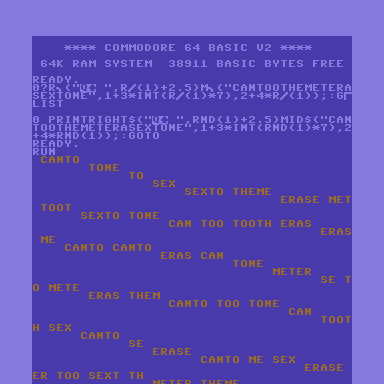
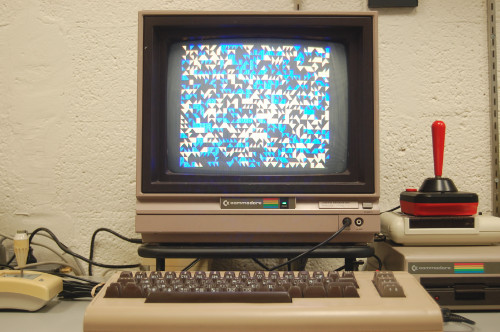
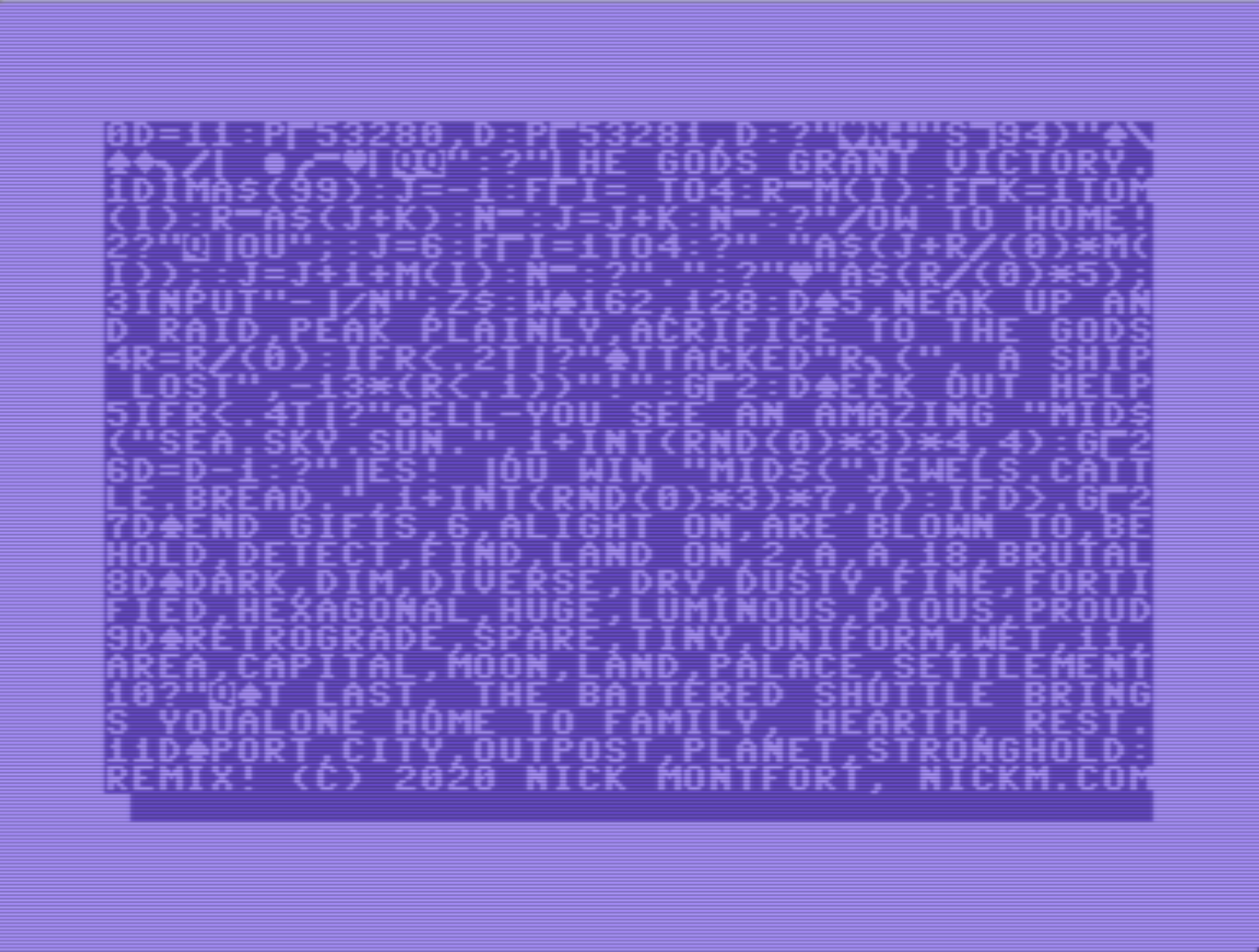
A: A quasi-spoiler here, but: it is a 12-line Commodore 64 BASIC program, with each line being of the maximum length that can be typed in: 80 characters, using all keyword abbreviations and other shortcuts. That makes it the maximal Commodore 64 BASIC program that will fit on one screen. On the second half of the last logical line (line 11), which is the last physical line of the screen, I included a sort of informal all-permissive free software license.
Q: Is this an experiment?
A: I don’t find it interesting to produce any IF, other digital games, other digital literature, or other digital art, unless what I’m doing is an experiment. So, of course.
Q: Is this a parody?
A: I don’t consider it to be, since you’re asking me. If you have thoughtfully considered the game and that’s what you take away from it, I respect your view.
Q: What am I supposed to do when playing this?
A: Since you’ve asked me, I’ve tried to explain this quite explicitly in the introduction: “If you allow your imagination to help you elaborate each stop on your journey, and if you truly get into the mindset of the returning wanderer, Amazing Quest will offer you rewards as you play it again and again.” You can read that, and the game, however you want, but I’d say that Amazing Quest prompts you to imagine, from the standpoint of the main character. So, imagine.
Q: “Oh hey, it’s A Space Odyssey!”
A: For me at least, I did consider Amazing Quest to be a serious engagement with Homer’s Odyssey, and that was one of the things that motivated my work on the project. I’m glad that some people saw this aspect of the project. I hope that enriched some people’s experience of it.
Q: “I found the intro and strategy guide more compelling than the game itself.”
A: Personally I would have preferred that all elements of Amazing Quest (the introduction, the strategy guide, the BASIC game itself) had worked together to good effect for you, but I’m glad that you liked something about the project. My development of the short framing texts was meant to relate to the way that early games had similar supporting materials that were essential to the experience. In any case, I am glad someone liked these texts, because it took me a long time to type them up on my Smith Corona Classic 12 without making any mistakes.
Q: “I don’t suspect that you’re in it for the ratings.”
Only one of more than 100 games was going to win the Comp. (Well, this year it happens to be two, because of a tie—but you get my point.) I made this game for the IF Comp so that players would encounter Amazing Quest and play it in that context, in case they found it compelling in that context.
Q: “I guess the point was go ‘behind the scenes’ and read the program in BASIC? That isn’t a particularly interesting goal…”
A: It wasn’t interesting to you, but there are many people in the world. One player ported the game to BBC Micro BASIC, so it seems like the nature of this game as a BASIC program was somehow interesting to that person. Even apparently simple projects like this may have many complex aspects to them which aren’t evident at first. And perhaps only a very few people will be interested in particular aspects. So in this case, perhaps this “behind the scenes” aspect is important to the person who ported it to the BBC Micro, and maybe it will be interesting to people who know Commodore 64 BASIC very well. I’m frankly surprised that someone engaged with the BASIC program so thoroughly during the Comp. It easily could have taken a few decades for anyone to really become interested in the game’s code, if that was ever going to happen.
Q: SPOILER, select the following text to read: The player’s input has no effect on the outcome, and that’s stupid.
A: Although this isn’t a question, I’ll mention: If you understand a little more about Commodore 64 BASIC, you’d find that the user’s input does have an effect on the outcome.
Q: SPOILER, select the following text to read: Okay, but whether you answer yes or no has no effect on the outcome.
A: This, while also not a question, is true. So, let’s begin with whether this is fair to players of the game. Does that contradict anything said on the main page (“I must decide as if it all depends on me, trust as if it all depends on the gods”), within the game itself (“The gods grant victory”), in the introduction, or in the strategy guide? And in terms of how this game relates to the Odyssey, in which a character is fated to return home, alone, from the beginning, and is then brought home by the will of the gods—is there any contradiction there? To continue along these lines, even understanding this aspect of the game, if you decided to go on raids at every opportunity, plundering away, would that be any different than if you always declined to raid? Is your intentional choice irrelevant, even if the outcome is “random”? With all of this in mind, consider something more concrete and immediate. Let’s consider people who live in the United States who voted in the 2020 election. Why would they do that? Realistically, an individual’s vote had no more effect than any one particular Y/N response in Amazing Quest. Let’s heap one more thing on here, purely related to what one might call gameplay. If you want to imagine what’s going on—a journey home—why would this particular property of the game in any way stifle your imagination?
Q: Was this project motivated by anything besides the Odyssey?
A: Yes. I’ll be discussing this and other matters related to Amazing Quest at the Seattle area IF meetup, which will take place online on December 13, 2020 at 2pm PST. If you want to join, you’ll need to email the organizers; see the intfiction.org forum for more information. I hope this group doesn’t regret their plan to host the author of the 98th place IF Comp 2020 game! I’m certainly still looking forward to discussing Amazing Quest.