Someone Hearts Taroko Gorge
Leonardo Flores of I ♥ E-Poetry is writing about 18 remixes of Taroko Gorge, one each day for the next 18 days.
Teaching Modern & Contemporary American Poetry to 36k
Al Filreis has taught his “ModPo” course at Penn for years; in Fall 2012 he offered a 10-week version of the course online, via Coursera, to more than 36,000 students. The course, as in its previous versions, does not include lectures, being based instead on discussion – the collaborative close readings of poems. The course grows out of Filreis’s work at the Kelly Writers House; he has been Faculty Director of this literary freespace since its founding in 1995. Filreis is also co-founder of PennSound, the Web’s main free archive of poetry readings, publisher of Jacket2 magazine, and producer and host of “PoemTalk,” a podcast/radio series of close readings of poems. In conversation with Nick Montfort, Filreis will discuss ModPo and his perspective on writing, teaching, and digital media.
Filreis is Kelly Professor of English and Director of the Center for Programs in Contemporary Writing at the University of Pennsylvania. He is the author of Wallace Stevens and the Actual World, Modernism from Right to Left, Counter-Revolution of the Word: The Conservative Attack on Modernism, 1945-60, and other works. He was chosen as Pennsylvania Professor of the Year by the Carnegie Foundation in 2000.
Co-sponsored by the SHASS Dean’s Office and the Literature Section.
All Purple Blurb events are free and open to the public. The Purple Blurb series is supported by the Angus N. MacDonald fund and Writing and Humanistic Studies.
The deadline for E-Poetry 2013 (to take place in London, at Kingston University) is almost here – sumissions are due December 1. The festival will take place June 17-20.
Sometimes I encounter language that sounds like it was computer-generated, or that sounds like it would be even better if it was. Hence, the slapdash “Lede,” which is based on the first sentence (no, not the whole first paragraph) of a news story that was brought to my attention on ifMUD.
This very simple system does incorporate one minor innovation, the function “fresh(),” which picks from all but the first element of an array and swaps the selection out so that it ends up at the beginning of the array. This means that it doesn’t ever pick the same selection twice in a row.
Happy Thanksgiving, my fellow Americans.
Illya Szilak interviews Nick Montfort in the article “The Death of the Novel: How E-Lit Revolutionizes Fiction,” the first of a series of posts on electronic literature.
I was at a workshop in Bergen on Tuesday and a conference in Edinburgh Thursday through Saturday. There were many interesting things to report or at least mention, and I’ve only managed to note two of them on the blog so far. I’ll also mention that in Bergen, I did the first transverse reading of the full ppg256 series, reading through the seven generators’ output four times. I was very pleased with the art gallery setting, the other readings and screenings, and the way my reading went.
Fortunately there is good documentation of both events in the ELMCIP Knowledge Base, a resource that lists critical work, events, and presentations about electronic literature as well as works of e-lit themselves. For these two events, abstracts and (in the case of the “Remediating the Social” ELMCIP conference in Edinburgh) full papers are included in the Knowledge Base as well.
For instance, my presentation in Bergen, represented by an abstract in the Knowledge Base, was “The ELO and Two E-Lit Exhibits.”
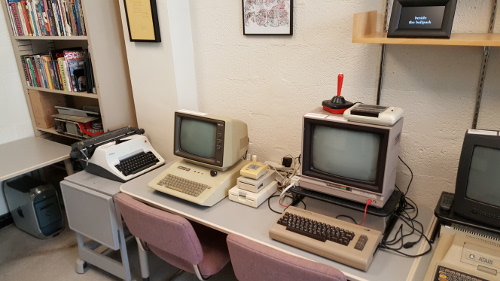
And, my keynote address at the beginning of the ELMCIP conference in Edinburgh was “Programming for Fun, Together,” for which a corresponding paper is available. I covered the main topics of the paper in about the first half of the talk and spent the second half trying to explain how to program in Commodore 64 BASIC, using concrete-poem-generating programs (including 10 PRINT CHR$(205.5+RND(1)); : GOTO 10) as my examples. I began by developing a program that prints “H” or “I” at random, using bpNichol’ favorite letter (“H”) and an adjacent letter that can be seen as either a rotation of “H” or a component of it. A one-line program was developed to printing either one uniformly at random. In part, this was my response to the less interesting but certainly more conventional “HELLO WORLD” program. I continued to show how a program that printed “x” or “y” could be quickly developed by modifying this one, after using Commodore BASIC itself, via the ASC function, to determine the appropriate new ASCII code. Then, I converted that program to “our” 10 PRINT (that is, the program I and nine co-authors have written a book about) and showed how the distribution and pair of characters could be changed.
In presenting these various 10 PRINT programs and developing new ones through modification, I wanted to show that BASIC programming can truly be undertaken in an exploratory way without a great deal of background. I also wanted to share with the group some of the amazing facility for poetic experimentation that is provided by a 30-year-old computer, inexpensive even at the time, that allows you to program immediately after being turned on.
Jill Walker Rettberg liveblogged my keynote (bringing back another wonderful historical tradition in digital media!) and there was also some discussion of the talk on Twitter.
My only regret related to the talk was that Rita Raley, who was scheduled to be the respondent for my talk, was unable to make it to the conference due to the storm damage and flooding in New York City. Scott Rettberg filled in and made a worthwhile connection from collaborative, social programming activity to collaborative writing, also questioning my four points about programming socially for fun.
The Edinburgh conference, which featured an exhibit at the Inspace gallery and performances throughout, resulted in a book that includes not only academic papers but also “artist’s pages” documenting the artistic works. I hope you’ll be interested in taking a look at the good supply of online “Remediating the Social” material.
Governor Romney said that was a tragic mistake; we should have left
I —
I —
period.
period.
are you —
are you —
in — in —
in — in —
no,
no,
I’ll tell you what’s worse.
I — I —
I — I —
we —
we —
went —
went —
more —
more —
no —
no —
all —
all —
We are not going to run away —
I do.
I do.
you —
you —
Step up.
Step up.
Let —
Let —
It’s —
It’s —
I —
I —
— my
— my
let —
let —
“Rough Cuts: Media and Design in Process,” a set of “middle-state artifacts” curated by Kari Kraus, has just been presented as part of The New Everyday, a project at MediaCommons.
My contribution is a printout of “Taroko Gorge” in the original Klingon Python. I also offer some discussion of this printed page, representing one phase of a poetry generator that has been reworked and plundered more than a dozen times.
Among several notable new articles in ebr (electronic book review), please find “Shuffle Literature and the Hand of Fate” by Zuzana Husárová and Nick Montfort:
Zuzana Husárová and Nick Montfort up the ante for experimental writing by examining the category of “shuffle literature.” What is shuffle literature? Simply put: books that are meant to be shuffled. Using formal reading of narrative and themes, but also a material reading of construction and production, Husárová and Montfort show that there are many writing practices and readerly strategies associated with this diverse category of literature.
Alternate (actually, rejected) titles for the famous journal L=A=N=G=U=A=G=E, recently revealed in Jacket2.
I don’t know about you, but Charles Bernstein and Bruce Andrews’s cutting room floor is often better than what ends up stuffed into my projector.
For instance, I see that Rhizome, which wound up being used, is on the list.
Maybe the next interactive fiction journal could be called Inventory.
And, I think Salad is still a great title – maybe even a better one today. It’s a dish best served cold.
News of a strange new social network, Monolyth, reaches us from December of this year and from Chris McDowall.
To sate the great appetites of the system, which will only publish messages at least 140,000 characters long (and will abbreviate longer ones), authors turn to unusual techniques.
One of these is generating massive texts using modified versions of Taroko Gorge, one of which is included in the blog post.
Welcome back to the Web’s major agglomeration of the avant-garde, Ubuweb.
(I don’t know that Ubu actually runs Ubuntu, but some statements are univocalically true regardless. And the site is back up, that’s for sure.)
I was extremely pleased to read Michael Leong’s discussion of Sea and Spar Between in At Length. Among other things, he considers in what way this could be considered a “long poem,” makes connections to Whitman’s “Crossing Brooklyn Ferry,” treats the interface and experience, and recounts a hilarious exchange between Toni Morrison and Oprah Winfrey. I really appreciated his discussion of different types of attention spans; these were issues that I (and I know Stephanie) have had in mind for quite a while.
At any rate, if you are interested in my & Stephanie Strickland’s Sea and Spar Between, or if you’ve been wondering about this piece but can’t figure out what to make of it, please take a look at Michael Leong’s article.
What are we waiting for, assembled in the forum?
A technical report is to arrive today.
No need to worry about what will become of you without a technical report! The report, the fourth “Trope Report” in the Trope Tank series that started this year, is here:
In “Carrying across Language and Code,” Natalia and I discuss issues of translation and computational writing. With reference to electronic literature translation projects in which we have been involved as translators or as authors of the source work, we argue that the process of translation can expose how language and computation interrelate in electronic literature. Various small poetry generators, a cybertext poem, and two works of interactive fiction are discussed in this report.
Share and enjoy…
As I wrote a few days ago, I made a statement about “Taroko Gorge,” and all of its vandals, at the ELO conference in Morgantown, WV.
Sepand Ansari created a Beckett-based “Taroko Gorge” remix at the ELO conference. And now I have the URL for this piece, “Waiting for Taroko Gorge.”
Kathi Inman Berens has created “Tournedo Gorge” “to mash the space of computation with the female, domestic, and tactile,” as she discusses in her blog post.
This was my statement for the “Taroko Gorge Remixed” panel yesterday (June 21) at the 2012 ELO conference. The panel was organized by Mark Sample and also featured Scott Rettberg, J. R. Carpenter (who joined us by video chat), Talan Memmott, Eric Snograss, Flourish Klink, and Andrew Plotkin. In attendance and part of the discussion were Leonardo Flores and Sonny Rae Tempest, who did work based on the Taroko Gorge code after the panel was proposed.
It is curious that I was invited to be part of this panel today, for I am the only speaker in this session who has not created and released a remix of Nick Montfort’s “Taroko Gorge.”
Today, however, to remedy this mismatch, to bridge this gap, to traverse this gorge, I am releasing a remix of my poetry generator, “Taroko Gorge.” This new work that I have completed and placed online today is also called “Taroko Gorge.” This remix was created to be an elegant poetry generator, producing a boundless nature poem and inspired by the experience of walking through Taroko Gorge National Park in Taiwan. The code of the program is the same as that of the original, and the text used as strings in the generator is also the same as that of the original. No comments have been added.
So, how can one distinguish this new “Taroko Gorge” from the original poetry generator of the same name? For one thing, I have placed today’s date on the right side of the page, to indicate that this is the remix that was completed today. When citing this work, you must also include the date that you accessed this page to comply with MLA, Chicago Manual of Style, and other bibliographic standards. If you leave the “Taroko Gorge” page open long enough, staring at it with meditative bliss, rapt attention, or monomaniacal trembling, you should include a date range rather than a single date in your bibliographic entry.
But enough of the temporal dimension. In addition to including a date, the new version of “Taroko Gorge” includes the names of all known vandals, those who have replaced my own lyrical words and phrases with ones associated with various other individual visions, ranging from the idiosyncratic to the downright perverse. These appear on the right-hand side – stricken out. Since it is not proper to condemn people without evidence – unless we put them aboard a plane and take them to another country – I have also included links to the offending Web pages.
This remix of “Taroko Gorge” asserts something very simple: that the rebirth of the author comes at the expense of the death of other authors. Something simple, about originality, voice, and purity of essence, which has been said in so many ways: Remix = death. Take back the gorge. Don’t tread on me. There’s a bear in the woods. Make it old. I did it my way. Under the page, the code.