Welcome back to the Web’s major agglomeration of the avant-garde, Ubuweb.
(I don’t know that Ubu actually runs Ubuntu, but some statements are univocalically true regardless. And the site is back up, that’s for sure.)


Nick Montfort
Welcome back to the Web’s major agglomeration of the avant-garde, Ubuweb.
(I don’t know that Ubu actually runs Ubuntu, but some statements are univocalically true regardless. And the site is back up, that’s for sure.)
What are we waiting for, assembled in the forum?
A technical report is to arrive today.
No need to worry about what will become of you without a technical report! The report, the fourth “Trope Report” in the Trope Tank series that started this year, is here:
In “Carrying across Language and Code,” Natalia and I discuss issues of translation and computational writing. With reference to electronic literature translation projects in which we have been involved as translators or as authors of the source work, we argue that the process of translation can expose how language and computation interrelate in electronic literature. Various small poetry generators, a cybertext poem, and two works of interactive fiction are discussed in this report.
Share and enjoy…
I presented the last ppg256 poem (ppg256-7) in Paris today at &Now.
Here are the current versions of all of the ppg256 poems/programs:
_I delivered this as the opening keynote at DiGRA Nordic 2012, today, June 7._
#### 1. The World of the Scene
Welcome to the world of the scene, to the summer of 2012, to that Earth where the demoscene is pervasive. Computers are mainly part of our culture because of their brilliant ability to produce spectacles, computationally generated spectacles that are accompanied by music, all of which is produced from tiny pieces of code, mostly in assembly language, always in real time. The coin of the realm is the demoscene _production,_ which includes graphics and chiptunes but is principally represented by demos and their smaller cousins, intros. The coin of the realm – although these are not exchanged commercially, but freely shared with all lovers of computation and art, worldwide.
The ability of these programs to connect the affordances of the computer with people’s capabilities for aesthetic appreciation, and the ability of programmers to continually uncover more potential in machines of whatever vintage, is the leading light in our world’s cultural activity and in the development of new technology as well. And it burns so brightly.
Computers, originally imagined as instruments of war, as business machines, as scientific apparatus, now are seen as platforms for beauty, as systems that can be rhythmical and narrative and can present architectural and urban possibilities as well as landscapes. One plays with the computer not by picking up a controller that is ready to receive one’s twitches but by thinking and typing at great length, by loading and storing, by writing programs.
People congregate in immense gatherings to program together and to appreciate intros, demos, and other productions running on the appropriate hardware. Of course they attend the classic parties such as Assembly in Helsinki, where they fill the Hartwall Areena. They come as well to the edgy and artsy Alternative Party in Finland. They also travel every summer to this world’s largest American demoparty, Segfault, which takes place at the Los Angeles Convention Center. Few of the sceners are even aware that a small but dedicated group of gamers is meeting at the same time in the same city, in a hotel, for their so-called “E3” gathering.
To exchange creative computer programs with one another, to annotate them and discuss them, a number of widely-used social media platforms have sprung up in our scener world. Some people used the video sharing service YouTube, but it is far less popular than YouCode, which allows the full power of the computer to be tapped and facilitates the exchange of assembly language programs.
In our scener world, a vibrant group of game developers and game players remains, of course, although they are not much talked about in the popular press, in the art world, or in academic discourse. California is something of a backwater in this relatively small pond of game development. Some development of games is still done there – first-person shooters, moderately multiplayer online role-playing games, and so on – but the games that have gained some purchase with the public come from elsewhere.
The two most prominent game developers are from Japan and Wales: Tetsuya Mizuguchi and Jeff Minter. Mizuguchi’s _Rez,_ as with with his many other excellent games, connects music and actions in a way that mainstream computer users – sceners – find particularly compelling. Minter’s graphical prowess, seen in _GridRunner_ and many other games, appeals to the popular crowd of sceners, too, as does his whimsical inclusion of ungulates in his games. The games by these two consistently have earned the highest level of praise from the world at large: “that could almost be a production.”
#### 2. Scener vs. Gamer
Now, as enjoyable as this vision is, let’s put this scener world on hold for a moment – not, of course, by pressing select on our XBox 360 controller, but by pressing the freeze button on our Commodore 64’s The Final Cartridge III – or, if we must resort to emulation, by selecting File > Pause from the VICE menus.
How does the scener world that can be glimpsed in the real Summer Assembly in Helsinki relate to this other universe we have surely heard about, the gamer world of Winter Assembly and this summer’s DiGRA Nordic in Tampere? How do the origins of computer and videogaming relate to the origins of the scene?
To relate gaming and the scene, something of course must be said about the nature of the demoscene. I am not here to provide a history of the scene, which is, of course, almost entirely a Northern European phenomenon and which is particularly strong in Finland. It would be absurd for me to come here and pretend to be an authority on the scene, ready to tell you the special things that I know and that you should know about it. It would be as absurd as my coming to tell you about how to properly use a sauna or about the strategic virtues of land mines. I come not to bury the scene in a dense, pedantic explanation – I come to praise it and to offer it my imagination, to embrace and extend it in the most non-proprietary way. My interest is in making the scene mine – and everyone’s. To do so, I will describe a bit about how the scene originated.
The idea of creating an impressive demo that will do something pleasing, playful, and impressive, and that will make use of computing technology, is probably a good bit older than the general-purpose computer. In the early days, it made no sense to divide the category “demo” from that of “game.” Consider the amazing computational project by Spanish engineer Leonardo Torres y Quevedo. This individual, who as part of his day job devised a type of semi-rigid airship that still excites steampunks, created a special-purpose automatic electronic chess player. This system was like the famous mechanical Turk, but with no dwarf inside. Torres y Quevedo’s incredible demo could play a chess endgame perfectly and even had a voice synthesis system – a phonograph – that enabled it to annouce check and checkmate. Since there were no demo parties at the time, his system was permiered at the World’s Fair, in 1914. Possibly the first demo (not on a general-purpose computer, to be sure, but an incredible and impressive demo nonetheless) was executed almost one hundred years ago, and was also possibly the first computer game. If World War I had not ensued the demoscene might have begun in full force the early years of the twentieth century, anticipating and perhaps inspiring general-purpose computers.
There were other demos and other game-demos in the days before the demoscene proper. In the former category were “recreational computing” programs developed at MIT to convert numbers from Arabic numerals to Roman numerals and back and the remarkable joke called “Expensive Typewriter,” which is possibly the first word processor; in the latter were _Tennis for Two,_ perhaps the playful TX-0 demo _Mouse in the Maze,_ and certainly the PDP-1 program _Spacewar._ The scene would have certainly applauded projects like these, along with the work of those who made the line printer produce music and who made pleasing sounds with radio interference on their Altair 8800.
While demos – usually what would be called “wild” demos and would do not fit into any standard demoscene category – abound throughout the twentieth century, the modern-day demoscene has a specific origin. This community, this constellation of creative practice, exists thanks to commercial game software and to the copy protection techniques used on it. The demoscene begins in the confluence of a computer game industry and the impulse to enforce legal restrictions on copying with technical ones. First, certain microcomputer disk drives working in certain modes can be used to _read_ data slightly better than they can _write_ data. Producers of video games – to be honest, not massive horrifying hegemonic corporations, in the early days, but often literaly mom and pop operations such as Sierra On-Line (Ken and Roberta Williams), Scott Adams games, Jordan Mechner, and so on – joined with early videogame publishers to implement so-called _copy protection_ for games delivered on floppy disc.
Copy protected discs could not be copied using the typical methods that one might employ to back up one’s own data. But they could be copied, sometimes using bit copiers with particular parameters and sometimes thanks to the efforts of early digital preservationists who performed an operation upon them known as _cracking_. By reverse-engineering these games and their protection schemes, and by twiddling a few bytes, crackers were able to liberate copy-protected games and allow ordinary users to make the legitimate backup copies to which they were entitled. While I was content to sector-edit my Apple II discs and change my _Bard’s Tale_ characters to have abilities of all 99s, and satisfied myself with placing my Apple //e and my duodrive and monitor in the trunk of my car and heading off to a copying party where warez could flow “the last mile” to end users, others, fortunately, did the difficult and elite work of liberating games in the first place.
This was another time, you understand – 1983-84 – and we had not recieved Bill Gates’s open letter to hobbyists that, had we read it, would have explained to us that we were stealing software. People would have ceased to crack and copy software if they knew that they were killing the game industry. And all the home computer software that is available and runnable today _only_ in cracked versions – now that the companies that were responsible for such software are gone completely or are nothing but a few confused lines on legal documents – all that software would be gone, immolated, left on the ash heap of history, like tears in rain.
But I am not discussing guilt, innocence, or disappearance; I am mentioning how the demoscene came to be. This activity of cracking software led those who were removing copy protection to enhance the software they were dealing with in certain ways. It was possible to tidy programs up and compress them a bit for easier copying. (This tradition is alive and well in many circles, including even electronic literature. Jim Andrews told the story at the Modern Language Association electronic literature reading of how, when one of his works was being translated into Finnish, Marko Niemi returned not only the translation but also a version of his program that was bug-fixed and tidied up.) If there was a little space on the disc, either to begin with or as a result of this compression, one could add a sort of splash screen that credited those who did the cracking and that pilloried the crackers’ enemies.
This sort of crack screen or “intro” to the game has to fit in a small amount of space; it was sometimes a static image, sometimes animated. Most importantly, it was the mustard seed that grew into the various elaborate productions of the demoscene, almost always non-interactive and no longer introducing any commercial game. Rather, the intros and longer demos that are shown nowadays, like the graphics and chiptunes that are also featured at demo parties, are there for their own sake. They do not introduce games, they do not introduce and flog new technologies, they simply demonstrate, or show, purely. Initially, they demonstrated one trick or a series of tricks tied together by very little – perhaps music, perhaps a certain graphical style. Now, in the era of design, demos tend to offer unity rather than units and often treat a theme, portray subjects, evoke a situation or narrative.
Certainly, the productions I am talking about demonstrate what they demonstrate to a technically adept, pseudonymous audience, groups that assemble or gather at events such as Assembly or the Gathering, mostly in Northern Europe. There are demo parties and parties featuring demos elsewhere, however, such as Block Party in the United States. In Boston, the recently-minted @party even has support from a local arts organization that runs a new media gallery and the Boston Cyberarts Festival.
But enough background; time to figure. The method I have used is not anthropological; I have not gone to ask sceners what they have already clearly said in one book, several articles, and a pair of documentaries. I am instead going to use a method where one talks not to people but to objects, where one reads and interprets specific computational texts. I am going to describe what these demos demonstrate, not technically, or not only technically, but culturally. Mackenzie Wark in his book _Gamer Theory_ argues that games offer us only an atopia, a blank placelessness; the productions of the demoscene, on the other hand, I argue, project utopias – not flawless ones, not ideals beyond critique, but utopias nonetheless. Instead of reading these visions as examples simplistic technofuturism devised by Pollyannas, I look at them as imagining new possibilities.
[I showed three demos running on a borrwed Windows computer – thanks to the conference organizers – and then showed them again without sound, discussing each of them.]
### 3. Computer Candy Overload
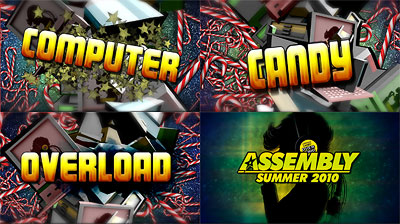
Gamers and sceners have often come to the same events — for instance, to Finland’s famous Assembly, up until 2007, when the event split into a gamer-oriented winter gathering here in Tampere and a scener-oriented summer one in Helsinki.
Let’s wait for this to explode …
This demo offers a great deal of junk food, of candy canes. Christmas in July, or, more precisely, in August. We progress, if it’s right to call it progress, backwards – in a retro-grade motion, powering into the past with today’s technology.
The demo we are now experiencing, “Computer Candy Overload” by United, is a special type of production that serves to invite people to an upcoming demo party. It advertises Summer Assembly 2010, of course, but is also an interesting starting point for discussion because it has many typical elements of modern-day demos, showcasing certain technical feats while being brought together by a contemporary concept of design. It took first place at @party the first year of that event, in 2010.
In this part of the demo, the flying clusters of objects that were seen earlier are still hurlting backwards through the air, but now, a generated city – an immense city, like a planar version of Issac Asimov’s planet-wide Trantor – is not only scrolling by as we fly backwards above it. The city is also rocking out, pulsing with the beat of the music, as much character as setting. The city, and then the planet.
Now, the direct address to @party, where this demo was released …
Now, the shout-outs, the naming of the most famous demoscene groups that will show themselves, and show their productions, at Assembly …
The shapes of the city again, first radial, then rotating on cubes …
This demo also offers us a flatted female image, a silhouette of the stereotypical hot chick licking a 9 volt battery – bringing together adolescent erotocism with, perhaps a titilating adolescent memory of a a literally electric encouter. To some, it could suggest that a woman can contribute approximately one bit, or one tongue, to the activities of the demoscene – that women can be at best mascots.
That would be an antagonistic reading, but consider that the cyborg-like woman is turning the industrial product of the battery from its intended use in consumer goods to the purpose of sensory stimulation. She is entering into an aesthetic relationship with this compact power source. And, as her image appears on row after row of homogenous computer monitors, she turns the banal laboratory and the corporate workplace into the creative frenzy of the demo party.
### 4. fr-025: the.popular.demo
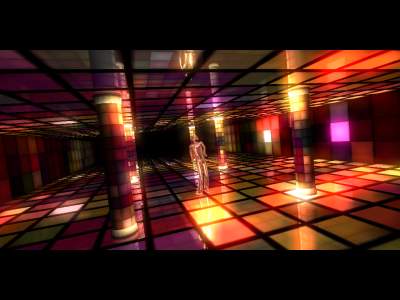
[An anti-virus warning came up at this point – the demo had been identified as a dangerous program. With the help of Finnish-speakers, I indicated that the computer should run the program.]
As game companies outsource the production of full motion video to pad their products with pre-rendered cutscenes, the demoscene, interested in “the art of real-time,” insists on rendering during execution and limits precalculation. This real-time quality is present in all demos, including the one shown earlier and the one other demo I will show. This one, “The Popular Demo” by farbrausch, was the 1st place PC demo from Breakpoint 2003. Yes, everything you see was produced by almost ten-year-old code, code that is practically classic.
Again, a reading that takes note of gender is interesting. Here we have an exuberant, highly reflective dancing figure. This dancing figure becomes first a trio of dancers and then a crowd. And this crowd, even if the original figure is slightly androgynous, is a crowd of dancing guys, relfecting not only the light but the typical almost entirely male demo party. Actually, the figure seems to me to be male because of the silvery Jockey shorts he is wearing.
We could chastise the demoscene for its lack of inclusiveness and for its occasional sexualization of women, but compare these demos to the recently released trailer for the videogame _Hitman Absolution,_ in which a group of women dressed as nuns casts off their habits, is seen to be wearing sluttly attire and sporting weapons, and then, after attacking the extremely bad-ass hitman, go on to be slaughtered one by one in gruesome detail. This trailer is not really that innovative in the area of violence against women — it simply conflates numerous action-movie clichés. But it still makes a much worse impression than demoscene productions do, because these productions are not, ultimately, about dominance and sadism. Demoscene productions are about exuberance, about abundance, about harmony. If they overlook or slight women now and then, this is a failing that should be remedied. It is one that can be remedies without altering the core dynamic of the scene and of productions.
Demoscene productions can be dark at times, but even when they are more industrial or grim, they are about elements working together and in sync. There is no player being thwarted by the stutter-step of the attacking computer, no need to break the pattern – only a pleasing spectacle, a dance of color and computation, a dance that results from the connection between coder and computation.
### 5. Elevated
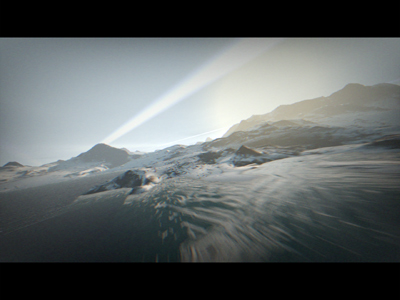
[As I was starting this one, a conference organizer said “please! The lowest resolution! This one is very demanding!”]
As games become more and more extensive in terms of assets and total program and data size, the demoscene flies into smaller and smaller pockets of inner space, creating self-contained 64K demos and 4K intros that run on standard operating systems – one scener, Viznut, even described in late 2011 how “256 bytes is becoming the new 4K.” Viznut, by the way, is from a country that starts with F, where people still smoke a reasonable number of cigarettes, that is not France. Viznut’s recent work has been to creating a 16-byte VIC-20 demo and to develop numerous very short C programs that generate music when their text output is redirected to /dev/audio.
The demo, or more precisely, intro that we are watching now is considerably larger, although all the code for it will comfortably and legibly fit on the screen. This is “elevated” by Rgba & TBC, the 1st place 4k Windows intro from Breakpoint 2009.
Notice the highly mannered, highly artificial way that the so-called camera (completely a second-order construction of the code, of course), calling attention to itself constantly, moves over this model of the natual world, this landscape. The landscape itself approaches the sublime, but the musical score and the movement and cutting work against that sublimity at least as much as they work to evoke it. And what could cut against the sublime more strongly that these beams of light, emanating as if from a club, or several clubs, calling the viewer to think of the music as diegetic, to imagine it happening on this alternate Earth.
Just as the city pulsed to the beat in “Computer Candy Overload,” just as the planet itself did, here the landscape remains static but emits these club-like clarions of light. The terrain itself is part of the party, nature blended with man without being violated. The elevated landscape is augmented without being touched so it can also kick out the jams.
### 6. Platform Studies & _10 PRINT_
A notable distinction between the demoscene and gaming is seen in their relationship to platform. Demoscene productions celebrate and explore the different capabilities of specific platforms, old and new, while the pressures of the market compel cross-platform game development, the smoothing over of platform differences, and the abandonment of older platforms. I don’t mean to say that game developers themselves aren’t aware of the differences between a mobile phone and a desktop, or even between an XBox 360 and a PC, which have very similar hardware but are distinct, for many reasons, as platforms. I simply mean that the impulse in game development is to try to smooth over the differences between platforms as much as possible, while those in the demoscene seek to explore and exploit particular platforms, showcasing their differences.
Ian Bogost and I have developed an approach to digital media that follows the demoscene in its concern for particular platforms, what they can and cannot do, and what their construction and use has to say about computing and culture. The approach is called platform studies, and book-length scholarly works using this approach are now being published in the Platform Studies series of the MIT Press.
_Racing the Beam: The Atari Video Computer System_ by Nick Montfort and Ian Bogost is the first book in this series. … The second book is _Codename Revolution: The Nintendo Wii Platform_ by Steven E. Jones and George K. Thiruvathukal … The third book in the Platform Studies series is _The Future Was Here: The Commodore Amiga_ by Jimmy Maher …
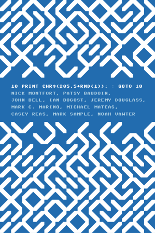
In November, the MIT Press will print my next collaboratively-written book, which will be part of a different but related series – the Software Studies series. This book is _10 PRINT CHR$(205.5+RND(1)); : GOTO 10_ by Nick Montfort, Patsy Baudoin, John Bell, Ian Bogost, Jeremy Douglass, Mark C. Marino, Michael Mateas, Casey Reas, Mark Sample, and Noah Vawter. You may have noticed that the title is practically unpronounceable and impossible to remember, and that the list of authors – there are ten of us – is also impossible to remember. We call the book _10 PRINT,_ and if you remember that you should be able to find out about it.
The book is an intensive and extensive reading, in a single voice, of the one-line Commodore 64 BASIC program that gives it its title. It is a transverse study of how this program functions, signifies, and connotes at the levels of reception, interface, form and function, code, and platform, considering both the BASIC language and the Commodore 64 as platforms. We discuss the relationship of randomness to regularity in this program and in computing, with one chapter devoted to randomness and one to various types of regularity, including the grid and iteration. We trace the academic origins and entrepreneurial implementation of BASIC for the Commodore 64, a programming language that was customized for the Commodore 64 by Ric Weiland and originally written for the 6502 processor by none other than Bill Gates himself. And we explain how the Commodore 64 shared features with other microcomputers of its time and was also distinct from them.
_10 PRINT_ is not a book about games, nor a game studies book, but it is a book that discusses computer games and relates them to another area of creative computing, hobbyist programming. The _10 PRINT_ program itself is neither a game nor a demo, but the book discusses the demoscene about as much as it does gaming, situating the practice of programming and sharing one-liners among these other practices.
The Library of Congress has assigned a call number for this book that places it among manuals for the BASIC programming language, so perhaps the book will be not only hard to recall by title and author but also hard to locate in libraries. It should be easy to read in another way, however, because like the demos I have been showing and discussing, like the 10 PRINT program, the _10 PRINT_ book will be made available online for free. The elite will want to purchase the beautiful physical object, a two-color book with custom endpapers designed by Casey Reas, the co-creator of Processing – but we make scholarship for the masses, not the classes.
But enough about books. Welcome back to the world of the scener, a world of parties, a world of exploring computation and the surprising abilities of specific platforms, a society of the spectacle that everyone can make. Here in the world of the scener, we are all equal and we are all totally elite. Think about a few questions this raises: Should your scholarship be distributed under the gamer model or the scener model? Are games all that can be done with computers, the only productions worth study, commentary, theorizing, and intellectual effort? I’m not inviting you to the next Assembly. I’m inviting us to see creative computing for what it is, something that includes videogames alongside hobbyist computing alongside digital art alongside electronic literature alongside the demoscene. Some of you know that it can be done, some believe that it can be done – so, a shout-out to you. And thanks to everyone for listening.
_The three demos I discussed are all available in executable form at pouet.net, which I have linked to and from which I have appropriated the three images. There is video documentation of them linked there, too._
Update: Thanks to Francisco Ricardo, a video of some of Christian’s Purple Blurb reading is now online.
The Spring 2012 Purple Blurb series comes to an end this week, not with a whimper, but with Christian Bök!
Thursday May 3
6-120
6pm
Christian Bök is the author of Crystallography (Coach House Press, 1994),
a pataphysical encyclopedia nominated for the Gerald Lampert Memorial
Award, and of Eunoia (Coach House Books, 2001), a bestselling work of
experimental literature, which has gone on to win the Griffin Prize for
Poetic Excellence. Bök has created artificial languages for two
television shows: Gene Roddenberry’s Earth: Final Conflict and Peter
Benchley’s Amazon. Bök has also earned many accolades for his virtuoso
performances of sound poetry (particularly the Ursonate by Kurt
Schwitters). His conceptual artworks (which include books built out of
Rubik’s cubes and Lego bricks) have appeared at the Marianne Boesky
Gallery in New York City as part of the exhibit Poetry Plastique. Bök is
currently a Professor of English at the University of Calgary.
If you’re in the Boston area, and interested in radical play with language (why else would you have found this blog?) please come by.
Un file de Machine Libertine:
… is a videopoem by Natali Fedorova and Taras Mashtalir. The text is a palindrome by Nick Montfort that briefly retells “Star Wars Episode IV: A New Hope,” making Han Solo central. The soundtrack is a remix of Commodore 64 music by Sven Schlünzen & Jörg Rosenstiel made by Mashtalir.
The palindrome is a revised version of the one Montfort wrote in 75 minutes for the First World Palindrome Championship, held in Brooklyn on March 16, 2012:
Wow, sagas!
Solo’s deed, civic deed.
Eye dewed, a doom-mood.
A pop …
Sis sees redder rotator.
Radar eye sees racecar X.
Dad did rotor gig.
Level sees reviver!
Solo’s deified!
Solo’s reviver sees level …
Gig rotor did dad!
X, racecar, sees eye.
Radar rotator, redder, sees sis …
Pop a doom-mood!
A dewed eye.
Deed, civic deed.
Solo’s sagas: wow.
Machine Libertine: http://machinelibertine.wordpress.com/
The big-screen premiere of Star Wars, Raw? Rats! will be at MIT in room 32-155 on Monday, April 30, 2012. The screening, which includes a set of films made by members of the MIT community, will begin at 6pm.
I’m reading soon with our Canadian guest Christian Bök and with my MIT colleague Amaranth Borsuk, who will present _Between Page and Screen_ (published by Siglio Press this year). The gig is at:
Lorem Ipsum Books
1299 Cambridge Street
Inman Square
Cambridge, MA
Ph: 617-497-7669
May 7, 2012 at 7pm
Amaranth Borsuk is the author of _Handiwork_ (2012), the chapbook _Tonal Saw_ (2010), and a collaborative work _Excess Exhibit_ to be released as both a limited-edition book and iPad application in 2012. Her poems, essays, and translations have been published widely in journals such as the _New American Writing, Los Angeles Review, Denver Quarterly, FIELD, and Columbia Poetry Review._ She has a Ph.D. in Literature and Creative Writing from USC and is currently a Mellon Postdoctoral Fellow in Comparative Media Studies, Writing and Humanistic Studies at MIT where she works on and teaches digital poetry, visual poetry, and creative writing workshops.
Christian Bök is the author of _Crystallography_ (2003), a pataphysical encyclopedia, and of _Eunoia_ (2009), a bestselling work of experimental literature. Bök has created artificial languages for two television shows: Gene Roddenberry’s _Earth: Final Conflict_ and Peter Benchley’s _Amazon._ Bök has also earned accolades for his virtuoso performances of sound poetry (particularly _Die Ursonate_ by Kurt Schwitters). Currently, he is conducting a conceptual experiment called _The Xenotext_ (which involves genetically engineering a bacterium so that it might become not only an archive for storing a poem in its genome for eternity, but also a machine for writing a poem as a protein in response). He teaches English at the University of Calgary.
Nick Montfort writes computational and constrained poetry, develops computer games, and is a critic, theorist, and scholar of computational art and media. He teaches at MIT and is currently serving as president of the Electronic Literature Organization. His digital media writing projects include the interactive fiction system Curveship; the group blog _Grand Text Auto;_ _Ream,_ a 500-page poem written on one day; _2002: A Palindrome Story,_ the longest literary palindrome (according the Oulipo), written with William Gillespie; _Implementation,_ a novel on stickers written with Scott Rettberg; and several works of interactive fiction: _Winchester’s Nightmare, Ad Verbum,_ and _Book and Volume._ His latest book, _Riddle & Bind_ (2010), contains literary riddles and constrained poems.
My word-palindrome writing project (being undertaken as @nickmofo) has been boosted by Christian proselytizing, by Bök’s page. I am delighted to be featured in Christian Bök’s post on Harriet as an instance of conceptual writing on Twitter – named, in fact, right after @Horse_ebooks.
This makes it particularly apt that Christian describes my writing as potential poetic “fodder.” Why not treat this feed of texts as the gift horse that keeps on giving? Please, feel free to make the tweets of @nickmofo into your chew toy.
Marty Markowitz, borough president of Brooklyn, said his borough was “the heart of America” in welcoming the 35th Annual American Crossword Puzzle Tournament. My heart was certainly in Brooklyn last weekend, both literally and figuratively. I was there to participate in the First Annual World Palindrome Championship on Friday and, on Saturday, to visit Big Reality, a wonderful, scruffy art show that included some of my work. More on Big Reality soon; here’s a belated note about the WPC.
I made into New York in time to meet at Jon Agee’s sister’s house in Brooklyn with him and several other palindromists who would be competing that evening. (Agee is a cartoonist whose books include Go Hang a Salami! I’m a Lasagna Hog! and Palindromania!) The other competitors included a fellow academic, John Connett, who is professor of Biostatistics at the University of Minnesota and an extremely prolific producer of sentence-length palindromes. Martin Clear, another author of many, many sentence-length palindromes, came from Australia. Barry Duncan, a Somerville resident and thus practically my neighbor, also joined us. Another competitor was Mark Saltveit, editor of The Palindromist and a stand-up comedian. And Douglas Fink, who won a celebrity palindrome contest with his now-famous entry “Lisa Bonet ate no basil,” was the audience contestant selected to join us.
I met Barry and Doug later that day, and had a great time sitting around and discussing palindromes with the others over lunch. We had plenty to talk about. It was interesting to see that we also had different perspectives, interests, and terms associated with the art. Jon thought “Er, eh – where?” was a good palindrome, probably in part because he was imagining how to illustrate it or frame it in a cartoon in a funny way. The others generally thought this one was bogus. A sentence was the desired outcome for most of us, while I was a fan (and writer) of longer palindromes. And, as we found out that night, the audience had their own tropisms and aesthetics when it comes to palindromes.
We had 75 minutes to write up to three palindromes that we’d read to the crowd, which was to vote for their two favorite. There were three possible constraints given: Use X and Z; Refer to events in the news in the past year; or refer to the crossword tournament itself. Here’s what I came up with, using the first constraint:
by Nick Montfort
Wow, sagas … Solo’s deed, civic deed.
Eye dewed, a doom-mood.
A pop.
Sis sees redder rotator.
Radar sees racecar X.
Oho! Ore-zero level sees reviver!
Solo’s deified!
Solo’s reviver sees level: ore-zero.
Oho: X, racecar, sees radar.
Rotator, redder, sees sis.
Pop a doom-mood!
A dewed eye.
Deed, civic deed.
Solo’s sagas: wow.
All of the results (and the text of the palindromes) are up on The Palindromist site – take a look!
Mark Saltveit became champ with a short palindrome about acrobatic Yak sex. John Connett got 2nd, Jon Agee 3rd, and yours truly 4th.
In mine, I count 54 words, 237 letters, and 327 characters. If “doom-mood” and the like are single words, we’d have 50 words. Mark says on The Palindromist site that it’s 57 words long; I’m not sure how the counting was done there.
In Barry’s, the only other possible contender, I count 70 words (as does Mark), 184 letters, and 311 characters. Some of those words are “7” and have no letters in them, as you’ll note if you check out the results page.
So, they’re both the longest: Barry’s has the most words, while mine has the most letters and characters.
It’s a sort of odd comparison, because the constraint I used (employ only palindromic words, counting things like “ore-zero” as words) let me reframe the problem as that of constructing a word palindrome with a restricted vocabulary. Of course, you should be very very impressed anyway, with my general cleverness and so on, but I think Barry chose a more difficult feat at the level of letter-by-letter construction.
Yes. A palindrome should be the right length. 2002 words is a good length if you’re trying to write a palindromic postmodern novel. For a snappy statement, a short sentence is a good length. I think some of the best palindromes are longer than a sentence and much shorter than 2002. My last edits to “The Millennium Falcon Rescue” were to cut several words (an even number, of course), and maybe I should have cut more? And, should I revise this one, I might cut the word that was included for the sake of the Z.
The most interesting thing about this event, for me, was a gathering focused on palindrome-writing. Kids know what palindromes are, the form of writing has been around for more than a thousand years, many people have palindromes memorized, and there are a handful of famous books … but as I see it there hasn’t even been a community of palindrome-writers, discussing writing methods, coming up with common terms and concepts, sharing poetic and aesthetic ideas.
Well, perhaps there has been, in the Bletchley Park codebreakers. But I only learned about them because I met Mark, who is one of the people researching the origins of famous palindromes. And that was, due to wartime security, a very secretive group.
It was great having the Championship hosted by Will Shortz at the American Crossword Puzzle Tournament, with many puzzle-solver and -constructors who are interested in formal engagements with language. Of course, palindrome events would fit will at other sorts of gatherings that are focused on poetry and writing, too.
Whether or not we have another championship (which would be great), it would be nice to have another summit of some sort and to build a community of practice around this longstanding practice. Particularly if we can get someone named Tim to join us: Tim must summit!
Mark J. Nelson has posted a very nice note about word-unit palindromes, mentioning that I have been tweeting palindromes-by-word as “@nickmofo” recently.
Nelson points out the paucity of such palindromes in the printed (and digital) record, and the lack of discussion about these. There are a few famous palindromes of this sort, including one that he mentions, “You can cage a swallow, can’t you, but you can’t swallow a cage, can you?” Another fairly well-known one is “King, are you glad you are king?” and another is “So patient a doctor to doctor a patient so.”
Without trying to add too much to this helpful discussion, I’ll note here that some of my tweets are meant to be amusing references to and reworkings of these more famous (for certain values of “famous”) word-unit palindromes:
You can mind a fashion, can’t you, but you can’t fashion a mind, can you?
(Oct 28, 2011)You can touch my bear, can’t you, but you can’t bear my touch, can you?
(Oct 25, 2011)Mister President, are you glad you are president, mister?
(Nov 28, 2011)So stiff a doctor to doctor a stiff so.
(Nov 27, 2011)
In case some of my palindromes seem more inscrutable than others, I’ll also note that my output includes tweets that pertain to things I saw (a VCR chained to a fence near MIT) and events that I attended (a poetry reading by Doug Nufer).

Holocaust Museum, Robert Fitterman, Veer Books, 9781907088346
Here is an extraordinary list, a simple and straightforwardly organized book of metadata (in this case, photo captions) that gives a very detached view of the 20th Century’s most unthinkable occurrence. What is fascinating is that while the book comments on some of the tropes of memorials, Holocaust museums, and records of trauma in general – enumeration, detachment, clear identification and humanization of individuals – it nevertheless becomes an effective testimony of the Holocaust and of how it was inextricably involved with ordinary life and events and histories, beyond the horrors that were ordered and organized:
> A German-Jewish family poses outdoors for a family portrait with their dog. [Photograph #69297]
The book is conceptual, but seems to be as far from a conceptual joke as is possible. Unlike much conceptual writing that begins with appropriation, it demands to be read entire. This is in many ways a simple book, and in many ways an extremely complex engagement with history, memory, and writing.

Found Poems, Bern Porter, new edition of a 1972 Something Else Press book, 9780982264591
Perhaps this exquisite collection of punctuation, numbers, and occasional letters recalls to the modern reader the idea of “uncreative writing” as described by Kenneth Goldsmith. I see it more as an example of subtractive writing: Creating new texts by erasure, or by cutting out text from advertisements, tables of technical information, and other ordinary but rich veins that can be mined for fragments of language. Each page can also be seen as a degenerate collage, a single clipping of text juxtaposed with nothing else (except what’s on the facing page). Porter, who was a publisher of radical writing and hoarded paper, never owned a phone or a computer. The book is, one might say, a real find, worth re-reading by anyone who seriously turns to contemporary poetry and conceptual writing, or indeed anyone fascinated with ordinary words locked in ads, fliers, and other everyday texts. At least do check out the fine related resources on UbuWeb’s Bern Porter page.
A group of sonic and code explorers has been discovering excellent super-short C programs that, piped to an 8-bit audio device, generate music. Here’s the first video and a second video with sounds and code.
Here’s the code for one example, “Lost in Space,” from video #2:
main(t){

for(t=0;;t++)putchar(

((t*(t>>8|t>>9)&46&t>>8))^(t&t>>13|t<<6)

);}
If you are also a righteous Ubuntu user, you can paste that into a file (let’s call it “lost_in_space.c”) and compile it with:
% gcc lost_in_space.c -o lost_in_space
Then, pipe it (or pretend to pipe it, using padsp, since recent versions of Ubuntu don’t have /dev/dsp) to your audio device using:
% ./lost_in_space | padsp tee /dev/dsp > /dev/null
Thanks to Andrew Stern for tipping me off about this one.
COMPUTER world hacked Mitnick
Digital being apprehended and N.C., It wasn’t five years in prison,
vid-like “A video friend)
Ghost in wizardry
Hacker attuned
recounts are one engineering”
cat-and-computer-to willingly provide
the online con his unknowing targets
I keep hearing about this Believer article about palindromes – actually, it’s mostly an article exposing a particular palindromist to readers’ chortles. The article signals no awareness of the palindrome as a literary form, but I appreciate it pointing me to Mr. Duncan’s “A Greenward Palindrome,” written for my local eco-boutique and charming in its topicality.
A community of practice is a set of people who do the same type of work (writing, art, game development, etc.) and who are at least aware of one another and have some interaction with one another. Poets constitute a community of practice, for instance, or at least several significantly interlocking communities of practice. Poets are aware that there are other poets. They read each others’ work. Sometimes they hate one another, which shows that they care.
Electronic literature authors are literary migrants to the computer, not always of the same genre or movement, and are less established as a single community of practice. But thanks to organizations like the Electronic Literature Organization and events like the E-Poetry festival and the ELO conference, many of them do get to meet each other, talk to each other, and learn about each others’ work and interests. Some specific sorts of practice, such as poetry generation, have much less community around them, of course; but others, such as interactive fiction, have a great deal of healthy community.
Palindromists, I would venture, do not constitute a community of practice. They mostly don’t know each other and aren’t aware of each others’ work, despite the efforts of people like Mark Saltveit, editor of the magazine The Palindromist. Duncan describes palindrome authors as “practicing the invisible craft.” When thinking of the short, canoncial palindromes that have circulated without attribution, this designation makes sense. But in other cases, it doesn’t.
For instance, there are plenty of palindrome books in print for those who look. Here are three from a single press, Spineless Books: 2002: A Palindrome Story by Nick Montfort and William Gillespie, I’d Revere Verdi: Palindromes for the Serious Music Lover by Jane Z. Smith and Barbara Thorburn, and the sublime Drawn Inward and Other Poems by Mike J. Maguire, which contains:
Same nice cinemas,
same nice cafe.We talk late.
We face cinemas.
Same nice cinemas.
There are several palindromes of literary interest online, too – my and William’s 2002 is just one, alongside “Dammit I’m Mad” by Demetri Martin and “The Big One” by Will Helston.
From reading that recent article, one would guess that palindromists aren’t a community of practice because palindrome writing isn’t a practice, but a pathology. The truth is that palindromes make for difficult reading, difficult writing, and unique engagements with language that have been savored by Edgar Allan Poe, Vladimir Nabokov, Harry Mathews, and Georges Perec. So, for those who want to take a break from gawking at personal quirks to read some brilliant texts, read a few of the many palindromes that are out there – works of writing that will wow you coming and going.
A collaborative story by Jesse Ashcraft-Johnson, Eleanor Crummé, Alex Ghaben, Cisco Gonzales, Ray Gonzalez, Boling Jiang, Nick Montfort, Shannon Moran, Kirsten Paredes, Carter Rice, Tyler Wagner, and Jia Zhu
“Mr. President, can you summarize the events of the G-6 conference?”
“First, a bunch of world leaders surrendered their favorite prostitutes. Then, we all yelled ‘Yeehaw!'” That was what George H. W. Bush thought, anyway, as he delivered a quick straight answer to the question.
“Mr. President, what was your holiday message to the troops?”
“I told the boys: either step up to the challenge or there will be no Christmas presents this year.”
When the photo-op smiles fell away, there was a moment of hesitation between Bush, Canadian Prime Minister Mulroney and Mexican President Salinas. The prepared statements about NAFTA were left on the podium, the talking points and teleprompters left in the press room with the reporters. Music swelled outside closed doors. “Well — either we dance or we lose ourselves in emerging global markets!” Bush blurted out, the twang in his voice inviting them to the hoedown.
Whiskey heavy on his breath, Bush turned to Salinas and elbowed him playfully. “Were you tutoring someone last night in long division? Either that was a very short 18-year-old or you might want to go see a priest. I hear they’re good with that sort of thing.”
He felt Mulroney’s eyes on him and turned abruptly. “Do you have a staring problem, boy? You’re looking at me like a damn homosexual. Either you face me like a man or spend the night. I’ll pound you ’till you’re tender.”
Mulroney flashed a smile, then started. A SWAT team was scaling the White House wall. “Look!” he said, gripping President Bush’s hand. “Either monkeys are flying out of your butt, or we should really rethink what we told the police last night. Maybe that anonymous call to the FBI tip line about hiding little boys in the attic wasn’t such a great idea.”
As their hands touched, Bush remembered the secret NAFTA initiation ceremony of the previous night.
Salinas had been pouring shots of tequila for a while. Stumbling up on top of the table, Bush called for attention and announced: “In order to promote unity, we must remove all barriers to our freedom. That includes our clothing.” Salinas nodded gravely, adding, “we must be pure and unfettered in body as well as soul.” There were noises of confusion from the others gathered there. “Hey, I’m from Texas, bitches. This is how we roll. Go big or go home!” Mulroney reached deep into his pants and pulled out a 12-ounce bottle of maple syrup. “Big enough for you, Bush?” he shouted as he chugged it down with a giant sucking sound.
One thing led to another. In the darkness, having slipped past the Secret Service, they ended up joining hands while riding bicycles naked down Pennsylvania Avenue.
Bush was snapped out of his reverie by the arrival of the NAFTA treasurer who had come to brief the world leaders, who were inebriated once again, on the state of the budget.
“First, take off your clothes,” Bush told him. “Then we’ll talk … ”
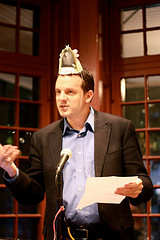 Video and audio of Oulipolooza, a festive tribute to the Oulipo in which I participated, is now online. The event was held on March 15, 2011 at the Kelly Writers House at Penn and was organized by Michelle Taransky and Sarah Arkebauer. Speakers were:
KATIE PRICE
LOUIS BURY
JEAN-MICHEL RABATÉ
GERALD PRINCE
and NICK MONTFORT
It was quite an honor to be part of this group, which included one of my Ph.D. advisors – Gerry Prince. I may have been the least distinguished Oulipo scholar among these speakers, but I tried to make up for that by being the only one to wear a party hat.