
Big Questions

Thursday 26 January 2012, 1:00 pm   /////  

Radical Books of 2011, 10/10

Big Questions, Anders Nilsen, Drawn & Quarterly, 9781770460478

Anders Nilsen has done exquisite sequential art, a.k.a. comix. I’m particularly fond of the trembling outlines and barely-representational figures in The End. The trade book of Big Questions is more conventional in style, but it binds 658 pages and 15 volumes of Nilsen’s work together in an extended, amazing story. In it, birds speak, but aren’t very smart. They devise their own ideas about a piece of unexploded ordnance, for instance, imagining it as an egg. An elderly woman dies in a plane crash; the idiot man-boy she has been caring for survives, as does the pilot. He also doesn’t seem too smart. The drawing style, which passes for simple at times but is nicely composed and filled with rich details, keys into the story, an animal tale that passes beyond childish simplicity. There are none of the mainstream superheros and no hint of the indie comics memoir in these ten years of work by a master of this art. Comic readers should love it; radical readers who wish to try out comics should try it.

Pale Fire: A Poem in four Cantos by John Shade

Wednesday 25 January 2012, 1:00 pm   /////  

Radical Books of 2011, 9/10

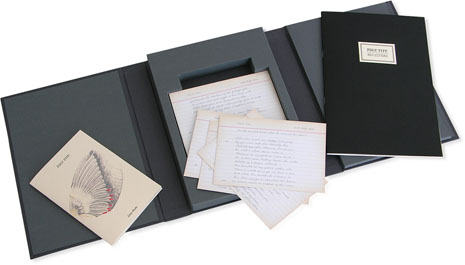
Vladimir Nabokov's poem Pale Fire

Pale Fire: A Poem in four Cantos by John Shade, Vladimir Nabokov, Ginkgo Press, 9781584234319

Extracting the poem (which only exists as a sort of in-joke in the radical novel Pale Fire) from what is perhaps (according, e.g., to Larry McCaffrey) the major English-language novel of the 20th Century? It’s at least a very extreme move. This edition drops the prose like a bad habit, makes like a banana and splits it off, makes like a tree and abandons House of Leaves prose for Leaves of Grass verse. Does it work in the sense of presenting a beautiful poem freed from its chrysalis? No. Much of it is still most notable for building up, and then comically deflating, the explicitly implied author, John Shade. It’s better as part of a narrative than as language trembling between sound and sense. But John Shade’s “Pale Fire” is not too bad of a poem qua poem, and reading it alone can certainly enhance one’s appreciation of the truly incredible novel that has been shucked off here. I haven’t read the included commentary, but must note that including commentary is an absolutely hilarious idea.

You Can’t Have Everything… Where Would You Put It!

Tuesday 24 January 2012, 10:57 pm   /////  

Radical Books of 2011, 8/10

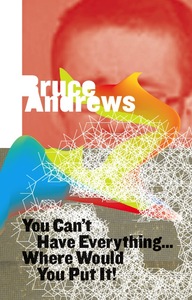
Bruce Andrews, You Can't Have Everything...

You Can’t Have Everything… Where Would You Put It!, Bruce Andrews, Veer Books

There is no way this book will get past your spam filter:

facework cootie itsier-off
we are the dream sequences in your conventional cultural life -

Indeed we are. Here’s verbal salad (French dressing? Russian dressing?) shot through at times with lines of split and reassembled words:

zy^rit
sect^in
sing^franchi
cres^offi

It’s a delight to apprehend such text, passing words beneath one’s eyes, thinking about what it all might mean and sound like. Looking back now, I wonder if I should have flipped this open and read at random when I encountered it originally. Instead of plodding through, I might have thought for days about a line such as “tractor the Real.” But, as it happens, I can still do that. Although I have everything, I had nowhere to put it. I have to delve in again for specific examples of juxtapositions that Bruce Andrews fashions. The book is no doubt worth reading, scanning, or hashing into – however you want to have it all.

Silence: Lectures and Writings

Saturday 7 January 2012, 1:00 pm   ////  

Radical Books of 2011, 7/10

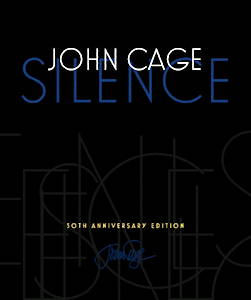
John Cage, Silence

Silence: Lectures and Writings, John Cage, 50th anniversary edition, Wesleyan University Press, 9780819571762

Stefan Helmreich and I were at dinner with a group and started talking about John Cage. The anechoic chamber Cage visited at Harvard is no longer there. MIT doesn’t have one, either. The best you can do (as a visiting sound artist found out) is arrange to visit Bose headquarters in Framingham, where they have a scruffy, industrial room – completely unlike the pure, science-fictional, sound-proof capsule a visitor would no doubt imagine. The point of Cage’s anechoic chamber story is that he heard a low-frequency and a high-frequency sound when he was in it; this was the circulation of his blood and the sound of his nervous system. This experience suggests we cannot truly hear silence, since we always produce sounds. Stefan suggested that perhaps profoundly deaf people can hear silence. I said that since the deaf can’t hear sounds, and since silence only exists as the complement of sound, perhaps they couldn’t really hear silence. Later, I realized that this would only be true of those who were deaf from birth.

Galerie de Difformité

Friday 6 January 2012, 1:00 pm   ////  

Radical Books of 2011, 6/10

Galerie de Difformité, Gretchen E. Henderson, &NOW Books, 9780982315637

Cross the form of a Choose-Your-Own-Adventure book with fragmented, cut-up, torn-up, stretched, and unconventionally printed text. Skip the “of” of an English title and give it a French name, using the “de” form. Bend book into blog. Deformity here includes transgressing the boundaries of authorship and inviting “user-generated” fascicles. Work the book’s text into something despicable or respectable: Fill out the form. Click to put Ye Ugly Face on Facebook. The story’s play of conspiracies and resurrections resonate with the transformations of the reading process that book and reader enact. Further, the exercises in textual topology – and lettered exhibits calling for further deformation – show that remixing is not just for one-note works such as Dramatic Chipmunk. The book, and indeed this thoughtfully developed artist’s book, can also serve as seed for elaborate transformation and convolution.

Holocaust Museum

Thursday 5 January 2012, 3:36 pm   //////  

Radical Books of 2011, 5/10

Robert Fitterman, Holocaust Museum

Holocaust Museum, Robert Fitterman, Veer Books, 9781907088346

Here is an extraordinary list, a simple and straightforwardly organized book of metadata (in this case, photo captions) that gives a very detached view of the 20th Century’s most unthinkable occurrence. What is fascinating is that while the book comments on some of the tropes of memorials, Holocaust museums, and records of trauma in general – enumeration, detachment, clear identification and humanization of individuals – it nevertheless becomes an effective testimony of the Holocaust and of how it was inextricably involved with ordinary life and events and histories, beyond the horrors that were ordered and organized:

A German-Jewish family poses outdoors for a family portrait with their dog. [Photograph #69297]

The book is conceptual, but seems to be as far from a conceptual joke as is possible. Unlike much conceptual writing that begins with appropriation, it demands to be read entire. This is in many ways a simple book, and in many ways an extremely complex engagement with history, memory, and writing.

Found Poems

Wednesday 4 January 2012, 1:00 pm   //////  

Radical Books of 2011, 4/10

Bern Porter, Found Poems

Found Poems, Bern Porter, new edition of a 1972 Something Else Press book, 9780982264591

Perhaps this exquisite collection of punctuation, numbers, and occasional letters recalls to the modern reader the idea of “uncreative writing” as described by Kenneth Goldsmith. I see it more as an example of subtractive writing: Creating new texts by erasure, or by cutting out text from advertisements, tables of technical information, and other ordinary but rich veins that can be mined for fragments of language. Each page can also be seen as a degenerate collage, a single clipping of text juxtaposed with nothing else (except what’s on the facing page). Porter, who was a publisher of radical writing and hoarded paper, never owned a phone or a computer. The book is, one might say, a real find, worth re-reading by anyone who seriously turns to contemporary poetry and conceptual writing, or indeed anyone fascinated with ordinary words locked in ads, fliers, and other everyday texts. At least do check out the fine related resources on UbuWeb’s Bern Porter page.

Motes

Tuesday 3 January 2012, 1:00 pm   /////  

Radical Books of 2011, 3/10

Motes, Craig Dworkin, Roof Books, 9781931824446

Short titles (or none) followed by hardly longer texts – the form is due to Bob Grenier’s A Day at the Beach and his materially innovative Sentences. Dworkin does something new, showing this is no one-trick pony and has use beyond a single poet. Zak Smith was the first to do a picture for every page of a novel (Gravity’s Rainbow) only to be followed by Matt Kish’s 2011 demonstration that the conceit had legs. Similarly, Dworkin innovates in Motes by being the second to try his hand at an unusual way of writing, and to show that it can amplify his different voice:

BRICK

Buick

Or:

MARGIN

explanation of butter on the counter overnight

While playing on Grenier’s everyday experiences, Dworkin’s motes take another turn, entering language and ordinary experience more deeply at times, as in the oddly compelling:

FOR THE WIDER GOOD

I am tiger woods

I am tiger woods

Alas.

It Is Almost That: A Collection of Image+Text Work by Women Artists & Writers

Monday 2 January 2012, 12:21 pm   ////  

Radical Books of 2011, 2/10

It Is Almost That: A Collection of Image+Text Work by Women Artists & Writers, Lisa Pearson, Siglio Press, 9780979956263

The writing here ranges from conceptual and all-text (as in Fiona Banner’s The Nam, composed of impassively typed descriptions of everything that happens in six famous Vietnam War films) to the highly visual (as in Suzanne Treister’s transformation of daily newspaper headlines into alchemical diagrams). One of Hannah Weiner’s journals in excerpted in manuscript; another selection is of small pages with brief, seemingly quotidian image-and-phrase pairings: from Docking Competitions by Erica van Horn & Laurie Clark. Some selections are entire works; others are excerpted well. A particularly nice selection is from the early computer poem A House of Dust by Alison Knowles and James Tenney, which shows the material nature of late-1960s computer output along with the formal possibilities the computer holds for recombining language. The twenty-six selections cover considerable visual, verbal, and conceptual terrain and produce excellent combinations of word and image that provoke and compel.

Moby-Dick in Pictures: One Drawing for Every Page

Sunday 1 January 2012, 12:21 pm   ////  

Radical Books of 2011, 1/10

Moby-Dick in Pictures: One Drawing for Every Page, Matt Kish, Tin House Books, 9781935639138

Combining his lack of formal artistic training, found paper from a used book store, and a 552-page paperback edition of Melville’s classic, Matt Kish – with the charm of an outsider artist but without the institutionalization or insanity – produces an utterly compelling visual journey through Ishmael’s adventures. There are striking colors and textures, odd forms – sometimes cranial, sometimes robotic. Unrolled image-by-image on Kish’s blog, the book-based drawings now make for a whale of a book; the original art is also, now, for sale (or sold). Unlike Tom Philips’s A Humament, the project doesn’t occlude text with image, rewriting a novel. Yet it is a forceful engagement with the page, with particular quotations, and with a encyclopedic story of obsession. The drawings are spare, powerful, and varied, in a flat illustrative style that doesn’t explain but does document one lengthy encounter with Moby-Dick.

Reader’s Block

Monday 28 February 2011, 11:33 am   /////  
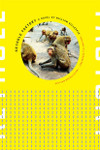
Reader's Block, David Markson, Dalkey Archive, 1996

Reader's Block, David Markson, Dalkey Archive, 1996

A pivotal point in this book – one that is reassuringly labeled “A Novel” – is the paragraph that reads, in its entirety, “Spent Adidas.” The other shoe drops. Imagination finally spills from one isolated paragraph to the next. This two-word paragraph does not stand out as unusually short among many that relating incidents or facts; literary, artistic, or philosophical deaths; and sometimes simply an author’s or some famous character’s name. How can we avoid being overwhelmed by the weight of what we know, what we have read about other lives? How can what we have learned about history frame, rather than imprison, what we seek to create as readers and writers? Why even attempt to imagine, when truth is stranger and so weighty? These questions raise themselves like ghosts in Hades scenting blood. As in Wittgenstein’s Mistress, a powerful image of a writer’s path of thought. Then, the poesies that succeeded in Borges’s “The Circular Ruins” takes a different turn in Reader’s Block, after a struggle.

Eden

Sunday 29 August 2010, 8:41 pm   ///////  
The Secret History of Science Fiction, edited by James Ptrick Kelly & John Kessel, Tachyon Publications, 2010

Eden, by Pablo Holmberg, Drawn & Quarterly, 2010

Yes, these comics sometimes veer into the extremely sappy, but they’re metafictional and wonderfully fabular throughout. Eden collects more than 100 simple four-panel strips featuring a diminutive, somewhat rabbit-like king, or at least, someone who wears a crown, in a magical land. An extremely insightful naïvite, of the sort that one hears in the occasional oracular pronunciation of a child, comes through at times. But these comics do not overlook death or other serious subjects. Holmberg, who writes and draws in Buenos Aires, has Eden and more available on his website, in Spanish. Odd that to learn about a Web comic, I had to go into my local comic store and buying a book, but it goes to show that book-based institutions have more than a retail function. And, it seems unlikely that Holmberg’s work would have appeared in translation without a publisher such as Drawn & Quarterly. Through such everyday efforts, we sometimes find the extraordinary.

The Secret History of Science Fiction

Wednesday 4 August 2010, 7:00 pm   /////  
The Secret History of Science Fiction, edited by James Ptrick Kelly & John Kessel, Tachyon Publications, 2010

The Secret History of Science Fiction, edited by James Ptrick Kelly & John Kessel, Tachyon Publications, 2010

This book seeks to prove that science fiction cannot really be distinguished from mainstream literature, arguing this in the introduction and in quotes before each story. Whether it prevails or not, it offers stories by some of the usual suspects (powerful ones by Ursula K. LeGuin and Connie Willis) some liminal figures (Johnathan Letham, who presents a prison made of criminals) and others – e.g., Don DeLillo, in whose story two men orbit Earth during World War III. (In a beautiful scene, they begin saying whatever they feel like as they calibrate the lethal system to their voiceprints.) There are non-human primates: T. C. Boyle’s tale of a man whose primatologist wife leaves him and George Saunders’s “93990,” a deft critique of science. Carter Scholz’s “The Nine Billion Names of God” has its own take on that author Pierre Menard, created by Borges. (Was he a science fiction author?) Even the weakest stories in here are well-written and worthwhile; most go far beyond that, making for a truly great collection.

Utensils in a Landscape

Monday 8 February 2010, 2:34 pm   //////  
Utensils in a Landscape, Chris Edwards, Stray Dog Editions, Vagabond Press, 2001

Utensils in a Landscape, Chris Edwards, Stray Dog Editions, Vagabond Press, 2001

Searching for something suitably disruptive in the landscape of Australia, where Jacket is rooted, I found this. The first poem is made from sometimes misquoted bits of The Book of Common Prayer and Burroughs’s “The Cut-Up Method …” With technical and abstract language, folklore, Mallarmé, and guy-on-guy action, the book offers all sorts of utensil viewing. And later, in “but me,” this reflection:

My project, which began in
one room of the abyss, soon spread toward a perimeter
you can imagine, should you be inclined to do so.

I usually prefer projects in which sources are altered sparingly and systematically – Craig Dworkin’s “Legion” is a brilliant example. These approximate centos work, though. The invented language weaves with the appropriated, making it seem that Edwards could have done it all with his pen – or all with his scissors.

Gatz

Saturday 9 January 2010, 11:46 pm   //////  
Gatz, Elevator Repair Service, directed by John Collins, at American Repertory Theater, Cambridge, MA, Jan 7-Feb 7 2010

Gatz, Elevator Repair Service, directed by John Collins, at American Repertory Theater, Cambridge, MA, Jan 7-Feb 7 2010

This play answers the question “what’s six and a half hours long, uses every word of The Great Gatsby as its text, and cannot be staged in New York?” Gatz is an admirable, extreme adaptation. Most of the words are spoken by Scott Shepherd, who reads Nick’s dialogue and his narration. A large cast voices other parts and also puts on effective dumbshows. On the empty space of the stage, a low-rent, aging office makes a second space which then is wittily made into a third, one which includes West Egg and Gatsby’s mansion. The set initially harbors a (broken) computer but is made to connect to the 1920s via windows, a swivel chair, and other elements. Actions are carried out before they are verbally narrated, so that the words sometimes become a sort of comical rimshot, anticipated by the actors; both actions and words get space of their own this way, too. The result, odd as it may seem, is both playful and faithful, capable of satisfying avant-garde theatergoers as well as great books enthusiasts.

A Casual Revolution

Wednesday 6 January 2010, 9:57 pm   //////  
A Casual Revolution: Reinventing Video Games and Their Players, Jesper Juul, The MIT Press, 2010

A Casual Revolution: Reinventing Video Games and Their Players, Jesper Juul, The MIT Press, 2010

Juul’s latest, like his Half-Real, offers many insights, particular and general, while being succinct and clear stylistically. The book is not just about matching tile games, although there’s a good chapter on them and their genealogy. It’s about the moment in the history of videogaming where games overflow their “hardcore” niche and begin to appeal to everyone. Juul describes the stereotypes of casual and hardcore games and players; then he demonstrates, using data from many interviews, exactly how they’re wrong. An important, high-level innovation involves figuring out how to study both games and players – in this case, to understand what exactly is meant by “casual games” and how much of what we associate with that has to do with “causal” modes of play. There’s also an excellent analysis of the social space of play in front of the screen, in Guitar Hero and Wii games. A Casual Revolution will be valuable for academics and those in industry, and will help keep the sun shining on games.

Babyfucker

Tuesday 20 October 2009, 8:36 pm   /////  
Babyfucker, Urs Allemann, trans. Peter Smith, biligual edition, Les Figues Press, 2010

Babyfucker, Urs Allemann, trans. Peter Smith, biligual edition, Les Figues Press, 2010

“… mirrors and copulation are abominable because they increase the number of men.” —Borges

Babyfucker is far more disturbing than the title suggests. The book, written by a Swiss author, spawned a controversy in Germany in 1991. It begins unabashedly with the sentence “I fuck babies,” which the narrator declares to be his sentence. It is the reader’s sentence, too. However, there are no detailed representations of infant pedophilia. There is terse, detached description of an impossible garret, filled with baskets of babies, supplied with a spigot and drain for morphine-laced milk; trepidation at humanity and new life; a man who sees himself in the mirror as a baby — then as made up, limb by limb, of babies. If there are specific sexual visions here, they must belong mainly to the reader, not the text. Among other unsettling things, the volume (which is yellow and pink, tiny, and cute) shows the reader’s involvement in literary atrocities, in any violation committed by shared imagination.

Next Page »
This work is licensed under a Creative Commons Attribution-Noncommercial-Share Alike 3.0 Unported License.
(c) 2012 Post Position | Barecity theme